Hey there! If this is your first time visiting China, you’ve come to the right place. From visas to transportation, and everything in between, I’ve got you covered. Trust me, traveling in China is simpler and more fun than you might think!
How to Apply for a Chinese Visa?
The first step to visiting China is obtaining a visa. The L visa (tourist visa) is the most common type. Start by filling out the visa application form. Once you’ve completed it, bring the required documents and head to the Chinese consulate in your area to submit and collect your visa.
China Visa Overview
- Number of Entries: Single, Double, Multiple
- Validity: One year, Two years, Five years, Ten years, etc.
- Duration of Stay: Single stay does not exceed 180 days
- Types of Visas: Work visa, Family visit visa, Tourist visa, Student visa, Business visa, etc.
China Visa Materials
- Passport: Valid for more than 6 months
- Visa Application Form and Photo: Recent, frontal, color, bareheaded, 2-inch
- Proof of Legal Residence or Stay: Required for applicants not applying in their home country
- Original Passport or Visa: Required for those who have changed their nationality
- Invitation Letter: For business, work, family visit visas, etc., an invitation letter from a Chinese entity (e.g., company, school, relatives, friends) is required
- Flight Tickets and Hotel Bookings: For tourist visas, proof of round-trip flight tickets and hotel reservations is usually required
China Visa Process
- Log in to the China Visa Application Service Center: Fill out the visa application form as prompted, submit and wait for the preliminary review to pass
- Check the Application Progress During Review: To avoid situations where additional materials are required
- After the Preliminary Review is Passed: Bring the required documents to the visa center for submission and payment as prompted by email
- Collect the Documents: Go to the visa center to collect the documents within the specified time using the collection slip
What to Expect Upon Arrival in China?
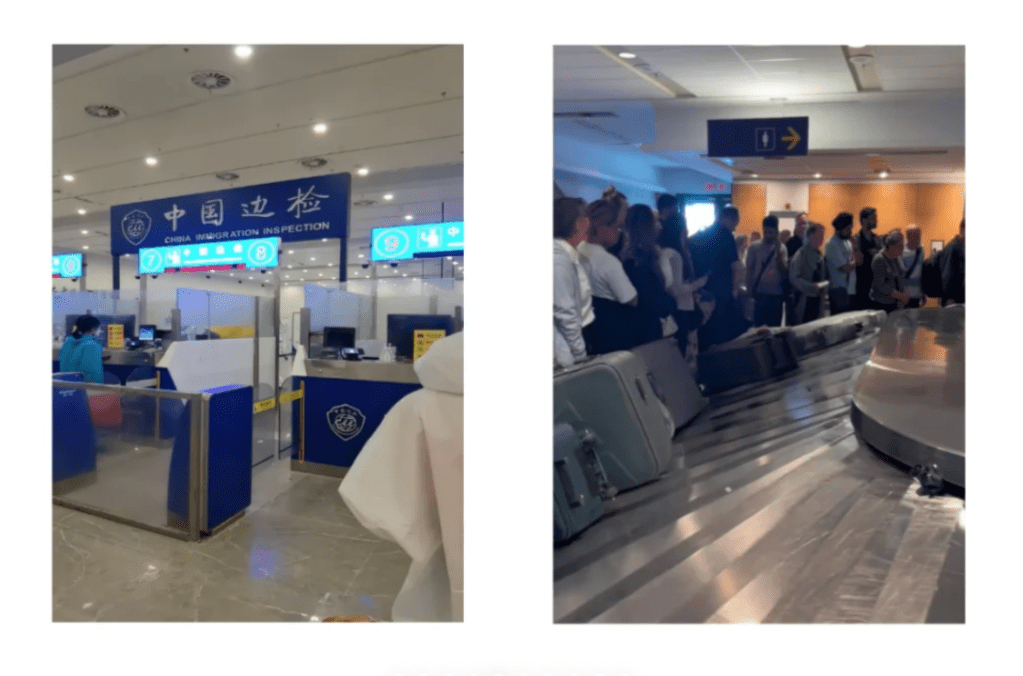
When you arrive in China, have your passport and visa ready. You’ll receive an entry card upon disembarking the plane, which you need to fill out. Next, proceed to the fingerprint scanner (available in multiple languages). If you’re unsure about the process, don’t worry—staff members are there to assist you. After that, simply join the queue at customs. You’ll likely be asked why you’re visiting China and how long you plan to stay. Answer clearly, and you’ll be good to go. Once you’ve collected your luggage, your Chinese adventure can officially begin!
① ARRIVAL Card Filling
- Arrival Card: Used to provide personal information, travel information, and health status to Chinese customs and immigration authorities.
- Filling Methods: Paper entry card, electronic entry card (self-declaration), China Customs “Self-Declaration for Entry” App.
- Customs Declaration: Certain items, such as large amounts of cash, medications, food, and animal and plant products, need to be declared. Failure to declare truthfully may result in penalties.

② Fingerprint Collection
- Fingerprint collection is unrelated to visa application and is merely a routine procedure upon entry.
- Fingerprint collection is free of charge and does not incur any additional fees.
- The fingerprint collection process is straightforward and only requires following the instructions on the self-service machine. After collection, you will receive a fingerprint collection receipt (with document number and time). Remember to keep it safe as it will be needed for immigration inspection.
- If you have already had your fingerprints collected before, you can directly print the receipt.

③ Customs Clearance Process
- Simply hand over your passport, entry card, and fingerprint collection receipt to the customs officer. They will then ask you some simple questions, such as “What is the purpose of your visit to China?” and “What is your destination?”. Just answer according to the actual situation, there is no need to be too nervous. They will also remind you of your allowed stay duration in China, which is very considerate!
- After that, follow the instructions to the baggage carousel to collect your luggage. At this point, your journey in China officially begins. The entire process is very simple!
How to Get Around in China?
Once you’ve reached your destination, several transportation options are available: subways, ride-hailing services, taxis, and buses. In major cities like Beijing, Shanghai, Guangzhou, Shenzhen, and Chengdu, the subway is the most convenient mode of transportation. The stations are well-signposted in both Chinese and English, making it nearly impossible to get lost. Note that Google Maps may not be as reliable here. Instead, consider using Amap for navigation.
Aircraft/High-Speed Rail
Many foreign friends, after arriving in China, will travel to multiple cities. Since the distances between cities are quite far, taking a plane or high-speed train is the fastest mode of transportation. Regarding ticket purchase: You can first undergo identity verification on the 12306 website. Once verified, you can conveniently buy tickets for planes or high-speed trains on various ticketing platforms.
Subway/Public Transport
For foreign friends who have arrived at their travel destinations, the most common modes of transportation are subways, buses, ride-hailing services, and taxis. Especially subways, which are highly favored in major Chinese cities such as Beijing, Shanghai, Shenzhen, Guangzhou, Chengdu, and Xi’an, can almost reach any place you want to visit (city tours). These modes of transportation are very convenient and can all be managed through a mobile phone. There will be an introduction on how to make payments later on.
Car/Bus
For foreign friends who want to experience natural scenery and engage in in-depth travel, the options are generally limited to cars or buses. For example, when traveling to places like Xinjiang, Tibet, and Western Sichuan, after arriving at the central city, due to limitations in transportation and geography, one can only reach various scenic spots by car. Natural beauty spots are usually far from urban areas, and both independent travel and self-driving have many inconveniences and safety hazards. It is recommended that foreign friends arrange their itineraries through travel agencies, which will be more relaxed and worry-free.
How to Overcome the Language Barrier?
Many foreign travelers worry about the language barrier in China. However, in big cities, staff at hotels, restaurants, and tourist attractions usually speak some English. In smaller cities, you might face a bit of a challenge, but translation apps like Google Translate can be a lifesaver. They can translate text from photos (like menus and signs) and even offer real-time voice translation. So, no need to stress!
How to Make Payments in China?
China’s mobile payment system is incredibly convenient. I highly recommend downloading Alipay or WeChat Pay. You can open an account using your passport, and almost every place—from luxury hotels to street food stalls—accepts QR code payments.
Bank Card Payment
If you hold a bank card with the UnionPay, Visa, or MasterCard logo, you can make card payments at merchants with the corresponding acceptance signs. If there is no sign, you can ask the cashier whether you can use your card for payment. If you have a UnionPay card, you can use it at all merchants within the country that have card payment terminals.
Mobile Payment
WeChat Pay & Alipay
Search for WeChat or Alipay in the app store on your phone, download and complete the verification, then bind your bank card to start using it.
Binding Process:
- Click on “Add Bank Card”
- Fill in card information (Card Info.), passport information (Passport Info.), and phone number (Phone Number)
- Fill in the verification code (Code)
- Enable payment function (Open Payment)
- Two payment methods: Scan to pay (Scan) and Pay/Receive code payment
Cash Payment
Mobile and bank card payments can solve 99% of payment issues in China, but during your travels, you may encounter situations where only cash is accepted, such as at attractions far from cities or in areas with poor signal. It is recommended that foreign friends exchange some cash for daily use (a few hundred yuan is sufficient) upon arriving in China.
How to Get a SIM Card
Channels for Getting a SIM Card
After arriving in China, it is recommended that foreign friends get a Chinese SIM card, as it is very convenient for both travel and communication.
Channels for Getting a SIM Card: You can apply for a SIM card at any store of China Telecom, China Mobile, or China Unicom (many airport lobbies also offer quick application services).
SIM Card Application Process
- Go to the store and apply for a SIM card, presenting your identification documents (passport, visa, etc.).
- Choose your preferred phone number and plan.
- Wait for real-name verification and business processing.
- Collect your SIM card and identification documents.
The entire process is very quick, so you don’t have to worry about spending too much time. After the SIM card is ready, the staff will assist you with activating the number. Make sure it works properly before leaving. If you need to apply for a bank card, remember to inform the staff when applying for the SIM card. They will give you a business acceptance form, which you will need when applying for the bank card.

What to See and Do in China?
China is a vast country with unique attractions in every corner. Here are some must-visit destinations:
- Beijing: The Forbidden City, Tiananmen Square, the Great Wall, Temple of Heaven, Nanluoguxiang, and Drum Tower Street.
- Shanghai: The Bund, Nanjing Road, Lujiazui, City God Temple, Yuyuan Garden, and Disneyland.
- Guangzhou: Sacred Heart Cathedral, Shamian Island, Dafo Temple, Canton Tower, and Yuexiu Park.
- Chengdu: Chunxi Road, Giant Panda Breeding Base, Jinli, Kuanzhai Alley, and People’s Park.
- Xi’an: The Terracotta Army, Ancient City Wall, and Muslim Street, with its rich historical atmosphere.
If you have more time, consider exploring Xinjiang, Tibet, Western Sichuan, Yunnan, and Zhangjiajie—each offers breathtaking landscapes and unique cultural experiences.
Enjoy your trip to China!
Food, Drink, and Fun Guide
Shanghai 3-Day Tour
- Day 1: Nanjing Road → Oriental Pearl Tower → Lujiazui → Shanghai IFC Mall → People’s Square → The Bund
- Day 2: Wukang Road → Anfu Road → Huaihai Middle Road → Jing’an Temple → Chenghuang Temple → Yu Garden
- Day 3: Disneyland → Head home
- Delicacies: Crab roe noodles, drunken crab, sticky rice cake, pan-fried buns, white-cut chicken, pork rib rice cake, eight-treasure duck, pastries, etc.
Beijing 3-Day Tour
- Day 1: Tiananmen Square → The Forbidden City Museum → Jingshan Park → Nanluoguxiang → Gulou Dajie
- Day 2: Temple of Heaven → Chairman Mao Memorial Hall → National Museum → Qianmen Street
- Day 3: Universal Studios → Head home
- Delicacies: Roast duck,爆肚 (beef tripe),京酱肉丝 (shredded pork in sweet bean sauce), Beier烤肉 (barbecue), mustard duck palms, Qianlong cabbage, dry-fried meatballs, Kung Pao chicken, etc.
Guangzhou 3-Day Tour
- Day 1: Sacred Heart Cathedral → Shamian Island → Yongqing Fang → Dafo Temple
- Day 2: Guangzhou Museum → Haixinsha → Canton Tower → Pearl River Night Cruise
- Day 3: Chen Clan Ancestral Hall → Sun Yat-sen Memorial Hall → Nanyue King Museum → Yuexiu Park → Head home
- Delicacies: Crab roe rice, Wen Ji Noodle Shop, Yingzi Fresh Milk, Lu Yun Tea House, beef brisket hotpot, char siu buns, sticky rice chicken, Yuan Ji Intestine Powder, etc.
Shenzhen 3-Day Tour
- Day 1: Window of the World → Happy Coast → Zhongying Street → Dongmen Old Street
- Day 2: Dapeng Fortress → Jiaochangwei → Gujiao Beach → Yangmeikeng
- Day 3: Shenzhen Bay Park → Dameisha → Xiaomeisha →仙湖植物园 (Xianhu Botanical Garden) → Head home
- Delicacies: Chaoba Zhen, Peng Xiaoguan, Gui Lao Ji, He Ji San Rao Jiao, Shanhe Tian, Bingcun Dashu Tangshui Dian, Yu Changxian, Ba Shu Feng, etc.
Chengdu 3-Day Tour
- Day 1: Chunxi Road → IFC Mall → Taikoo Li → Daci Temple → Wangping Street
- Day 2: Chengdu Museum → People’s Park → Wuhou Temple → Jinli Street → Jiu Yan Qiao
- Day 3: Panda Base → Wenshu Monastery → Du Fu Thatched Cottage → Huanhua Creek Park → Kuanzhai Alley → Head home
- Delicacies: Hongtang Lao Hot Pot, Xiang Fei Po Rice Shop, QDoug Flowers, Guo Qiao, Sweet水面 (Sweet Noodles), Chuan Chuan Xiang, Rabbit Head, Tang You Guo Zi (Sweet Oil Fruits), Ti Hua, Bo Bo Chicken, etc.
Xi’an 3-Day Tour
Delicacies: Rou Jia Mo (Chinese Hamburger), Hu La Tang, Zhan Gao, You Cha Ma Hua (Oil TeaMaHua), Yang Rou Pao Mo (Mutton Soup with Bread), You Po Mian (Oil Slanting Noodles), Shi Zi Bing (Persimmon Cake), Shui Pen Yang Rou (Water Basin Mutton), Hu Lu Ji (Gourd Chicken), etc.
Day 1: Bell Tower → Drum Tower → Gao’s Courtyard → Xi’an City Wall → Sai Jin Qiao
Day 2: Xiaonan Morning Market → Shaanxi History Museum → Big Wild Goose Pagoda → Grand View City → Xi’an Art Museum → Datang Everbright City
Day 3: Terracotta Army → Huaqing Palace → Lishan → Chang Hen Ge (Eternal Regret Song) → Head home

