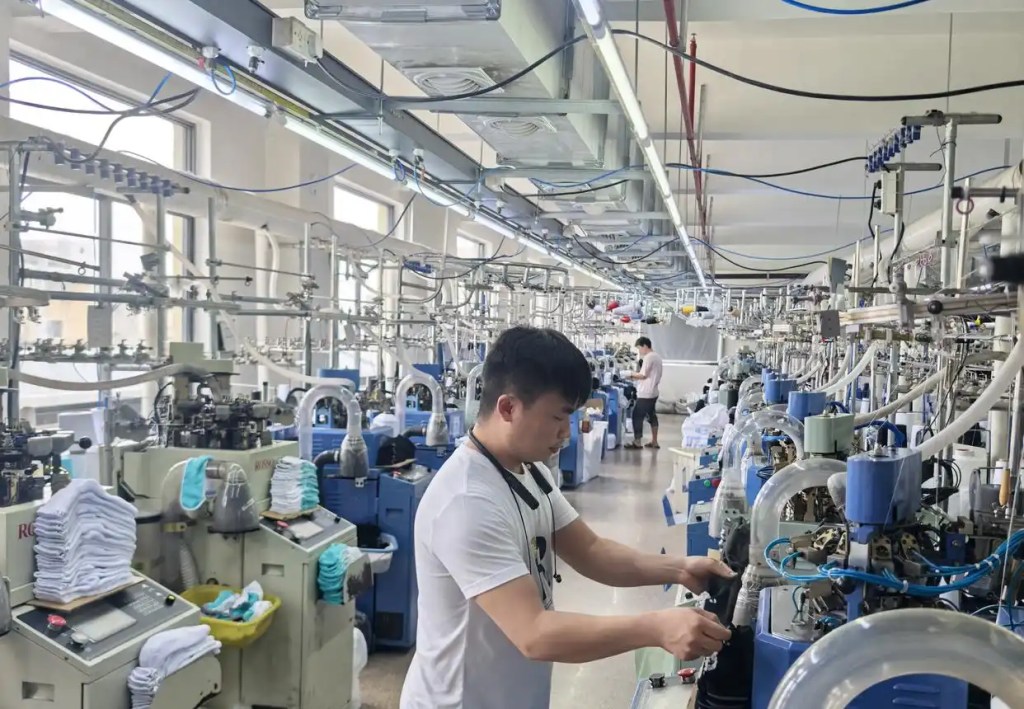
Jingwen Company, picture provided by the interviewee
The foreign trade industry has ushered in a 90-day window of opportunity.
Red Star Capital Bureau has learned that the foreign trade orders that were suspended due to the Sino-US tariffs have been restarted. Foreign trade factories are shipping goods. A foreign trade company received a large order of 300,000 pairs of socks from a US customer on the second day after the statements were issued by both China and the United States.
With the restart of orders, the transportation capacity of the Sino-US shipping route is in short supply, and there has been a price increase. On the shipping route from Dalian to Los Angeles, the price of a large container has increased by about 71%, and the price of a small container has increased by about 100%.
The Suspended US Orders Have Been Restarted
A New Order of 300,000 Pairs of Socks Has Been Received
Earlier, when the tariffs between China and the United States soared, the relevant foreign trade orders were once pressed the “pause button”.
Wendy works for a US home textile company and is responsible for purchasing home textiles such as bedding and towels from Chinese factories. She told Red Star Capital Bureau that at that time, no one could afford the high tariffs. Some orders from the United States were cancelled, and domestic factories suspended the production and shipment of relevant orders.
Yiwu Jingwen Import and Export Co., Ltd. (hereinafter referred to as “Jingwen Company”) also suspended its business dealings with US customers. “(US orders) Some are suspended in production, and some are suspended in placing orders. Both parties have decided to slow down; orders from other countries are still normal.”
However, on May 12, China and the United States issued the “Sino-US Geneva Economic and Trade Talks Joint Statement”, and both sides promised that “the 24% tariff will be suspended for the initial 90 days.” This has brought a 90-day window of opportunity for the foreign trade industry.
Wu Qingfen, General Manager of Jingwen Company, told Red Star Capital Bureau that after the statement was issued by both China and the United States, on May 13, they received a large order of 300,000 pairs of socks from an old US customer.
“Our production cycle is generally 30 to 35 days, but this customer is special. Some previous orders were suspended. Now we are required to complete the order before June 20. We also hope to help our US customers ship the goods to the United States within the 90-day window of opportunity, so that customers can stock more goods and improve their resilience.” Wu Qingfen told Red Star Capital Bureau.
Wendy also told Red Star Capital Bureau that domestic manufacturers are stepping up shipments. “The previous orders were stopped due to tariffs. Now, for the orders at hand, we will ship out as much as possible. If there are new orders, we will also strive to implement the shipment within the 90-day window of opportunity.”
The Price of Sea Freight Logistics Is Surging
The Freight of a 20-Foot Container Has Doubled
Red Star Capital Bureau learned from the interview that affected by the Sino-US tariffs, the transportation capacity of some shipping routes has been transferred to other markets, and there is a shortage of transportation capacity on the Sino-US route, resulting in a price increase.
Some media reported that data released by the trade tracking agency Vizion showed that after the mutual tariff reduction between the United States and China, the booking volume of container transportation from China to the United States for orders placed in the United States has soared by nearly 300%.
Ben Tracy, Vice President of Strategic Business Development at Vizion, said that the average booking volume for the seven days as of May 5 was 5,709 standard containers, and the average booking volume for the seven days as of May 14 soared by 277% to 21,530 standard containers.
On May 15, Red Star Capital Bureau consulted a sea freight logistics company as a customer. The relevant person in charge told Red Star Capital Bureau that it is now in a stage of price increase. Even if there is only a difference of one or two days, the price difference is large. There is no shortage of goods now, and the price may increase at any time.
Taking the shipping route from Dalian, China to Los Angeles, the United States as an example, the relevant person in charge told Red Star Capital Bureau that the previous price of this route was $1,000 per small container (20-foot container) and $1,400 per large container (40-foot container); according to the shipping schedule on May 22, the price of the same shipping route has risen to $2,000 per small container and $2,400 per large container.
That is to say, the price increase of large containers is about 71%, and the price increase of small containers is about 100%.
At the same time, the relevant person in charge also told Red Star Capital Bureau that the price is now calculated based on the time when the container returns to the port instead of the booking time, and the price may continue to increase on the basis of the above quotation.
The relevant person in charge of another sea freight logistics company told Red Star Capital Bureau that currently, the market quotation of the Sino-US shipping route is very chaotic, and it is expected to increase further.


Leave a Reply