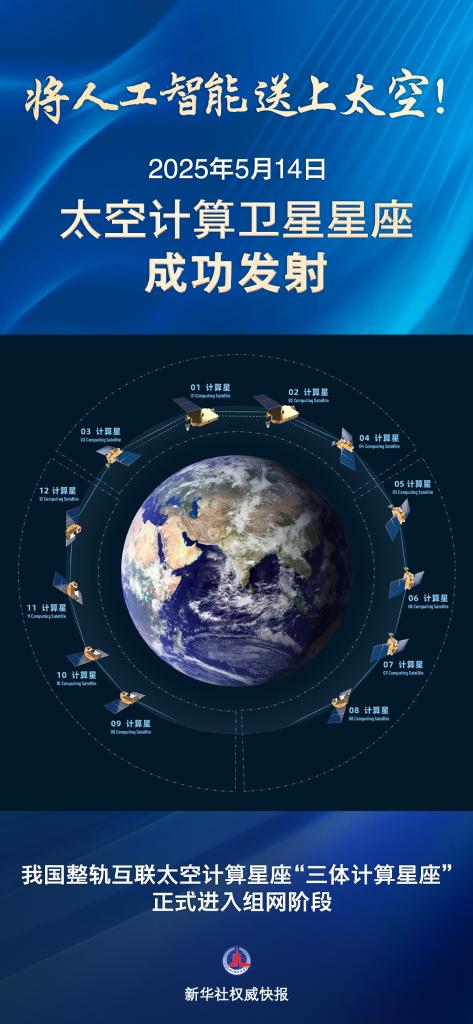
On May 14, 2025, at 12:12, China successfully launched the space computing satellite constellation using the Long March 2D carrier rocket at the Jiuquan Satellite Launch Center. The satellites smoothly entered the predetermined orbit, and the launch mission was a complete success. Industry experts believe that this marks the beginning of the “space computing era” in China. So, what is space computing? And what does it mean for us? What challenges lie ahead?
From 0 to 1: The Successful Launch of the Space Computing Constellation
“Star computing” was first proposed by Guoxing Aerospace, aiming to launch computing servers into orbit to form a space-based computing network.
In November 2024, Zhijiang Laboratory and Guoxing Aerospace announced the launch of the “Star Computing” plan and the “Three-Body Computing Constellation”. This successful launch means the first networking of this plan.
The first constellation of 12 computing satellites was independently developed by Guoxing Aerospace. According to the relevant person in charge of Guoxing Aerospace, this constellation will complete the verification and application of the basic functions of the space-based computing system, such as establishing links, networking, and forming a cloud.
“Since each satellite has the capabilities of space computing and space interconnection, after the constellation is networked, it will form space-based computing power, which will greatly improve the real-time performance of ‘heaven-earth remote sensing’ data and the efficiency of satellite applications,” the person in charge said.
The space computing constellation mission is named “021”, which means a breakthrough from 0 to 1 (0 to 1). Wang Jian, an academician of the Chinese Academy of Sciences and Director of Zhijiang Laboratory, said: “Artificial intelligence should not be absent from space due to the lack of computing power. With the computing constellation, a single satellite can also reflect the value of computing power, which has far-reaching significance for industrial transformation.”
Wang Jianyu, an academician of the Chinese Academy of Sciences and President of the Hangzhou Institute for Advanced Study, University of Chinese Academy of Sciences, said that as the resolution of satellite Earth observation becomes higher and higher, the amount of data is also increasing. Sending all the data to the ground for processing not only has a large transmission volume, but also affects the timeliness of data application. Through space computing, using artificial intelligence technology in space to process the data and then transmit it down will play a role in promoting industrial development.
What Can Space-Based Computing Bring?
Wang Jianyu said that the main reason for developing a new generation of computing power satellite networking is that it can significantly improve the real-time analysis and processing ability of satellites for ground information, bringing a large number of new application scenarios in industries such as forest fire prevention, national land, environmental protection, earthquake, and emergency response.
Xu Yangsheng, an academician of the Chinese Academy of Engineering and President of The Chinese University of Hong Kong, Shenzhen, said that “space AI” sends computing power into space in the form of satellite carriers, realizing the transformation from “calculating celestial data on the ground” to “calculating celestial data in space”. Through AI empowerment, it effectively improves the performance of single satellites and constellations, serving the high-quality development of national strategies and regional industries.
According to the relevant person in charge of Guoxing Aerospace, the realization of “calculating celestial data in space” can, in terms of time, improve the traditional satellite data processing response time from weeks or days to seconds. By carrying multiple payloads such as infrared and ADS-B, it can provide global forest fire monitoring and perception in seconds, real-time monitoring and positioning of low-altitude aircraft, and can be widely applied to scenarios with low-latency requirements such as emergency safety, urban governance, and low-altitude economy.
In terms of space, it can realize the on-orbit real-time processing of satellite data from two dimensions to three dimensions. Through on-board instant computing, AI algorithms can convert two-dimensional remote sensing planar images into three-dimensional models, and can provide satellite three-dimensional digital twin cultural tourism, entertainment, games, and other products for digital economy scenarios.
In addition, “Star Computing” can also provide a three-dimensional navigation system for low-altitude aircraft in the low-altitude economy scenario, and provide an embodied intelligence holographic city training ground for the robot scenario.
What Challenges Need to Be Overcome?
The future overall plan of “Star Computing” is to network 2,800 computing power satellites and connect them with ground computing centers to build a future space-ground integrated computing network. However, currently, there are still many challenges to be overcome in terms of technology and management for the development of the space computing power satellite network.
First of all, the space environment is different from the ground environment, and it is necessary to solve the problems of energy supply and device heat dissipation for computing power.
Wang Jianyu said that the space environment has characteristics such as high vacuum, high radiation, microgravity, and extreme temperature changes, which pose extremely high requirements for the materials and electronic components of computing equipment. It is necessary to develop special materials and components that can resist space radiation, adapt to the high vacuum and microgravity environment, and work stably under extreme temperatures to ensure the long-term reliability and stability of the equipment in the space environment.
Secondly, whether the launch cost can be reduced is also the key to the success of the plan.
At present, the deployment of a large-scale constellation with more than a thousand stars requires an investment of billions of dollars. Even if the reusable rocket technology can continuously reduce the launch cost of a single satellite, the commercial return cycle is still unclear.
Finally, the lifespan of a satellite is usually 5 to 10 years, and continuous investment is required for energy supply, orbit maintenance, and software and hardware upgrades during the lifespan cycle. If the failure rate of computing equipment is too high, such as the failure of memory caused by radiation, the replacement cost will further increase.
The industry believes that these challenges will be gradually solved with the maturity of technology. The relevant person in charge of Guoxing Aerospace said that the company has already started to invest in the research and development of satellites with higher computing power, and the 02 group constellation of the “Star Computing” plan has also entered the design and development stage.
Wang Jianyu believes that “Star Computing” requires a large amount of resource support. Relying solely on a few enterprises is not enough, and more social forces need to participate


Leave a Reply