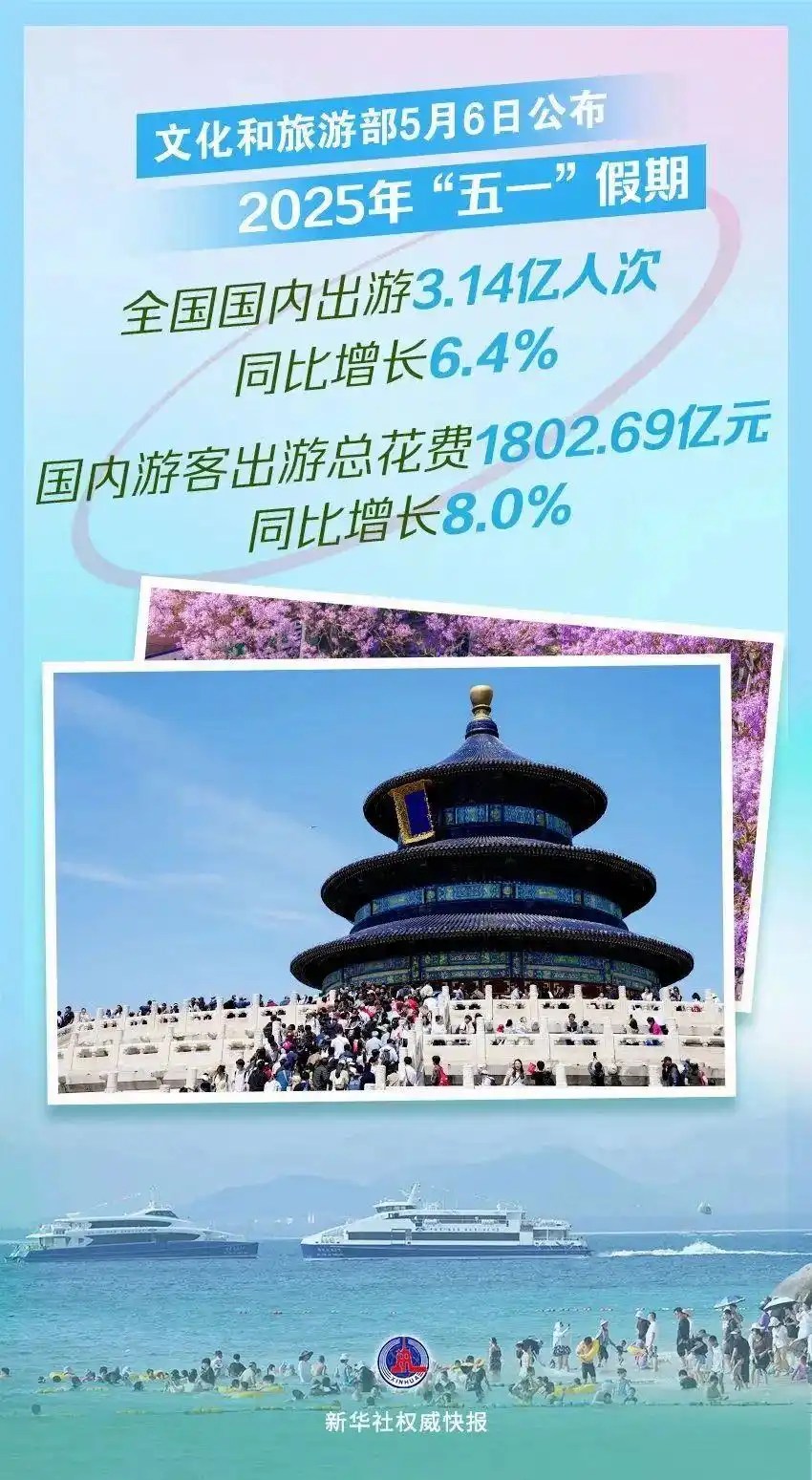
During the “May Day” holiday in 2025, various regions rolled out a rich variety of tourism products, cultural activities, and preferential measures for the public, striving to meet the diverse and personalized needs of the people. According to the calculation of the Data Center of the Ministry of Culture and Tourism, during the five-day holiday, a total of 314 million domestic trips were made across the country, showing a year-on-year increase of 6.4%. The total tourism spending of domestic tourists reached 180.269 billion yuan, growing by 8.0% year-on-year.
There was a rich and colorful supply of products and services. Local areas innovated and enriched consumption scenarios, stimulating consumption potential and market vitality with diverse offerings to provide tourists with in-depth experiences. They delved deep into the connotations of the festival, launching special experience activities such as farming exhibitions, showcasing the beauty of labor and culture. In Suzhou, Jiangsu Province, the city-wide “AI Peak Avoidance” feature helped tourists optimize their itineraries. The Qingcheng Mountain Scenic Area in Sichuan Province introduced an exoskeleton robot and a drone delivery system service, bringing a brand-new experience to tourists through intelligent services. The nighttime cultural and tourism economy was booming. Many places in Guangxi activated the night economy through diverse business forms such as public-benefit carnivals, themed light shows, and characteristic music festivals. During the holiday, the cumulative nighttime passenger flow of the national-level nighttime cultural and tourism consumption agglomeration areas under monitoring reached 75.9544 million person-times, increasing by 5.2% year-on-year.
Streets in ancient alleys, tourism performances, and new cultural spaces were all bustling with popularity. Tourist attractions, resorts, leisure streets, and cultural and museum venues in popular cities witnessed concentrated passenger flows. Ancient alleys in cities like Tengchong, Yunnan Province, and Xixian County, Shanxi Province, continued to gain popularity. Places such as Anqing, Anhui Province, and Kashgar, Xinjiang Uygur Autonomous Region integrated cultural performances into tourism scenarios, turning cultural highlights into tourism hotspots and launching high-quality and popular cultural and tourism products. The Moon River Book Bazaar in Tongzhou, Beijing, and the Futian Coffee Life Week in Shenzhen, Guangdong Province, had a strong cultural atmosphere. Many regions innovatively launched diverse business forms such as the rejuvenation of intangible cultural heritages and trendy experiences. Events like the Zhangzhou Puppet Carnival in Fujian Province and the Hand-painted Lanterns at the Zigong Lantern Museum in Sichuan Province were highly favored by tourists.
Both the inbound and outbound tourism markets witnessed a rise in popularity. The inbound tourism market continued to recover. Myanmar, South Korea, Malaysia, Australia, the United Kingdom, Thailand, the Philippines, Russia, Vietnam, and Japan were the main sources of inbound tourists, accounting for 57.4% of the total number of foreign tourists. Attractions like the drone light show and Kuixing Tower in Chongqing attracted a large number of inbound tourists to take photos. Cultural and creative IP products represented by giant pandas were deeply loved by foreign tourists. The outbound tourism market remained hot. Japan, South Korea, Singapore, Vietnam, Malaysia, Thailand, Indonesia, Australia, Cambodia, and Russia were the main outbound tourism destinations.
Preferential cultural and tourism activities were carried out intensively. The Ministry of Culture and Tourism guided local cultural and tourism departments and relevant industry associations to launch a series of preferential measures, including consumption vouchers for cultural and tourism, promotions of reduced or waived scenic spot tickets, and tourist shuttle buses. Local areas collaborated with transportation, accommodation, and financial enterprises to enrich consumption preferential measures and high-quality products, and issued electronic consumption coupon packages for tourism shopping on cooperative platforms. The China Tourism Scenic Area Association drove its member units to launch the “Scenic Area Happy Consumption Season.” The China Association of Travel Services advocated that travel agencies offer preferential packages such as free scenic spot tickets, hotel discounts, and air ticket price reductions.


Leave a Reply