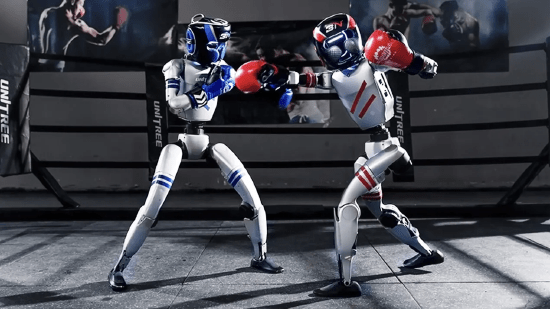
On May 25th, the Mecha Fighting Arena Competition of the “CMG World Robot Competition · Series Competition” was held in Hangzhou. This is the world’s first fighting competition with humanoid robots as the main participants, and Unitree Robotics Co., Ltd. (hereinafter referred to as “Unitree Robotics”) participated as a partner.
In terms of the competition system, there were a total of 4 teams participating in this competition. Each team remotely controlled the Unitree G1 robot manually by real human players to conduct confrontations. Punches, side kicks, dodges… The close “hand-to-hand” combat of iron armor and steel fists made science fiction come into reality.
In addition to the highlights of the competition itself, under the working conditions of intense collisions and high-energy consumption output, how are the coordination ability and stability performance of the robots?
Wang Qixin, a director of Unitree Robotics, said during the competition live broadcast: “It’s not an easy thing to make a robot learn a set of movements. Actually, we all rely on AI technical means to let the robot learn. Firstly, motion capture is based on some professional fighting athletes. According to their motion capture data, the robot learns these movements in a virtual world.”
Sun Baoyan, the marketing manager of Unitree Robotics, said in an interview with the media before the competition: “We hope that humanoid robots can gradually achieve some production functions within 3 to 5 years.”
What are the current technical difficulties faced by humanoid robot fighting?
Lu Hanchen, the director of the High-tech Robot Industry Research Institute, told the reporter of the “Securities Daily” that humanoid robots need to maintain bipedal stability under the stressed state during intense confrontations, which puts forward extremely high requirements for the control algorithm. The phenomenon of losing balance and falling down due to side kicks is common in the competition, reflecting that the dynamic balance system needs to deal with challenges in three dimensions simultaneously: real-time compensation for external impact forces (such as the center of gravity shift when being hit), offsetting its own motion inertia (such as the reaction force when throwing a punch), and the uncertainty of the ground contact surface (such as changes in the material of the arena).
In the fighting competition, continuous high-intensity actions may lead to the shutdown and overheating problems of the joints of humanoid robots. The intense collisions in the fighting will inevitably put forward higher requirements for the impact resistance and service life of the joints of humanoid robots.
Lu Hanchen believes that the battery life bottleneck will become one of the limitations for the practical application of humanoid robots. How to meet the long battery life demand under high-intensity confrontation is the key, and the thermal management problem tests the joint design and heat dissipation technology. In addition, the instantaneous power fluctuation also poses a severe challenge to the power management system. For example, actions like tackling need to reach a peak power of 3000W.
Yuan Shuai, the deputy secretary-general of the Zhongguancun Internet of Things Industry Alliance, told the reporter of the “Securities Daily” that the robot fighting competition brings science fiction elements into reality and can stimulate the interest and enthusiasm of the public, especially teenagers, in science and technology. “In addition, the technological progress shown in the robot fighting competition also provides room for imagination for the application of humanoid robots in more fields in the future, such as rescue, security, and service; it provides new ideas and methods to solve some practical problems and promotes the society to develop towards a more intelligent and automated direction.”
 Chinatimenow
Leave a comment