
On the evening of May 26, 2025, Arm updated its press release on its official website, clarifying that the Xuanjie O1 chip was independently developed by Xiaomi, correcting the previous description of “Custom Silicon.” This confirmation marks a significant milestone in the 15-year collaboration between Arm and Xiaomi. The press release states that Xiaomi’s newly developed chip, based on the Arm architecture, showcases the strong partnership between the two tech giants.
The Xuanjie O1 chip, crafted by Xiaomi’s in-house Xuanjie chip team, utilizes the latest Armv9.2 Cortex CPU cluster IP, Immortalis GPU IP, and CoreLink system interconnect IP. It fully supports the advanced 3nm manufacturing process. Thanks to the meticulous back-end and system-level design by Xiaomi’s Xuanjie team, the chip delivers remarkable performance and energy efficiency.
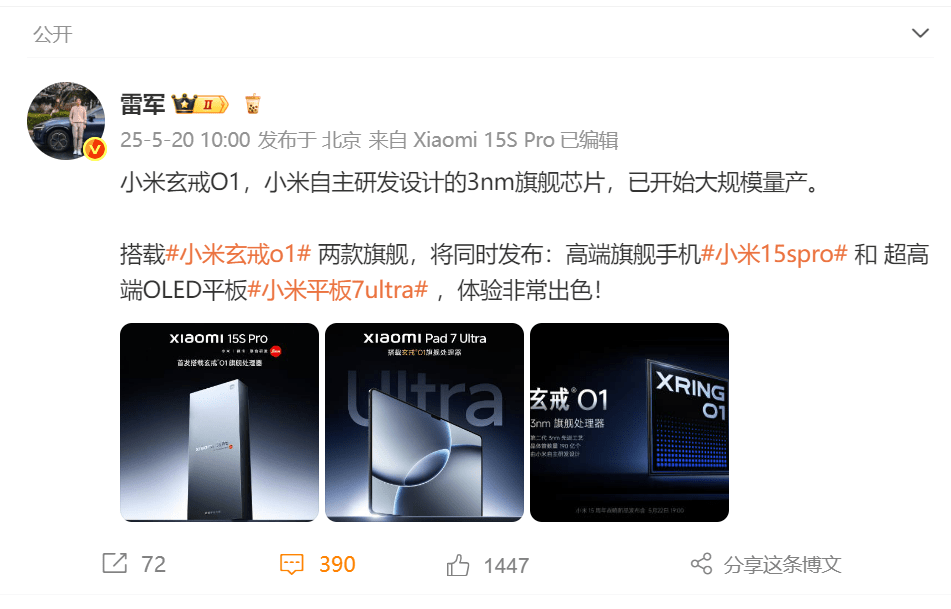
Also on the evening of May 26, Xiaomi released “Answers to Netizens’ Questions about Xiaomi’s 15th Anniversary Products (Episode 2).” Regarding the rumor that the Xuanjie O1 chip was customized from Arm, Xiaomi firmly denied it, emphasizing that this is completely false. During the R & D process, Arm’s CSS service was not employed either.
The Xuanjie O1 is a 3nm flagship SoC that Xiaomi’s Xuanjie team has spent over four years independently researching and designing. While it is based on Arm’s latest CPU and GPU standard IP licenses, the multi-core and memory access system-level design, as well as the back-end physical implementation, were all independently completed by the Xuanjie team. It is far from the rumor of using a complete solution provided by Arm, and the claim of “customizing the chip from Arm” is simply baseless.
The CPU super core of Xiaomi’s Xuanjie O1 can reach a maximum clock speed of 3.9GHz, significantly exceeding industry-standard designs. This outstanding achievement is the result of numerous innovations by the Xuanjie team and hundreds of iterations of layout optimization.
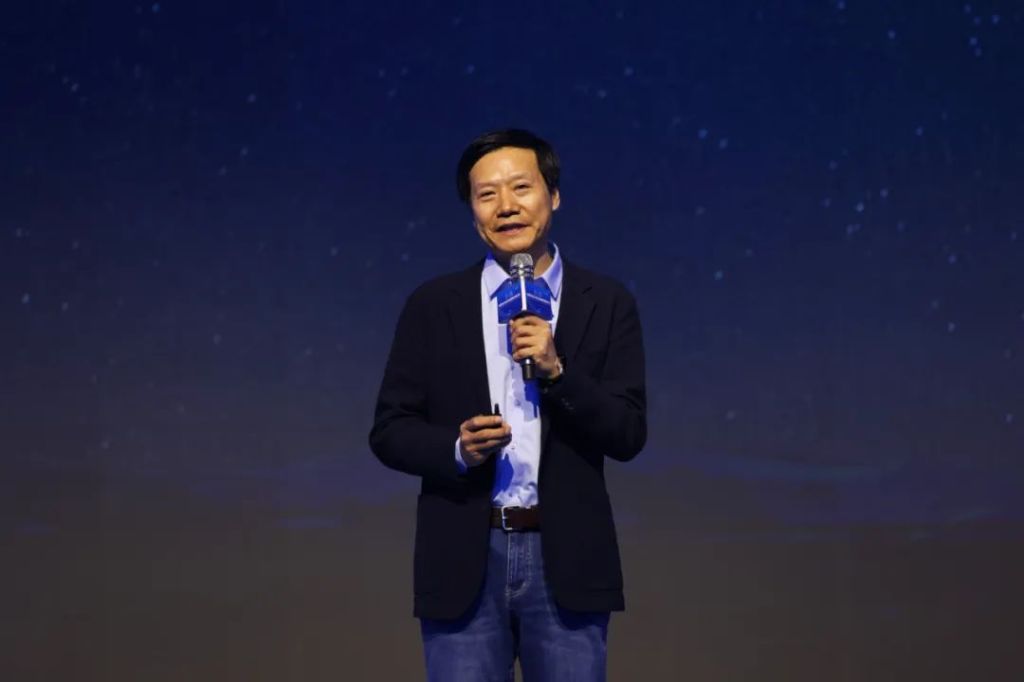
On May 20, Lei Jun, Chairman of Xiaomi Group, announced on Weibo that the Xiaomi Xuanjie O1, the company’s independently developed 3nm flagship chip, has entered mass production. On May 19, Lei Jun, the founder of Xiaomi Group, posted on Weibo, reviewing Xiaomi’s “chip-making journey” and revealing that the Xiaomi Xuanjie O1 uses the second-generation 3nm process technology, which is much more advanced than the previously speculated 7nm and 4nm.
Zhang Binlei, Co-Founder of Zhenxinhui, told reporters from National Business Daily that chip manufacturing process technology is crucial for the performance of mobile phone chips. From 28nm smartphone chips to 7nm and below chips for 5G phones, each technological advancement has brought significant performance improvements.
Why does Xiaomi invest heavily in chasing advanced processes? In the industry’s view, for Xiaomi itself, mastering the 3nm process will increase its bargaining power with chip suppliers. Strategically, self-developed chips provide Xiaomi with an alternative solution to cope with supply chain risks and also serve as a defense against the label of “reliance on imports.” However, from the perspective of product sales and market share, this decision is not expected to have a significant short-term impact, and future foundry capabilities remain a key constraint. Once this bottleneck is broken through, the experience accumulated by Xiaomi’s chip team will be more valuable. In addition, with the popularization of 5G phones and the future iteration of 6G communication technology, advanced manufacturing processes have become crucial for mobile phone chips. Xiaomi’s choice leaves room for future optimization and avoids redundant efforts.
Looking at the list of companies that have successfully taped out, Xiaomi has become the fourth company globally, following Apple, Qualcomm, and MediaTek, to release an independently developed 3nm mobile processor chip.
In terms of investment costs, the average cost of designing a 28nm chip is $40 million; the cost of a 7nm chip is approximately $217 million; a 5nm chip costs $416 million; and the overall design and development cost of a 3nm chip is close to $1 billion. As of the end of April this year, Xiaomi has invested 13.5 billion yuan in the research and development of this chip. Lei Jun also stated that the current size of the relevant R & D team has exceeded 2,500 people, and the R & D investment is expected to exceed 6 billion yuan this year.
Lei Jun described Xiaomi’s efforts as follows: “In the current domestic semiconductor design field, in terms of both R & D investment and team size, we rank among the top three in the industry. Without great determination, courage, sufficient R & D investment, and technical strength, Xuanjie would not have come this far.” However, he also admitted that compared with the accumulation of peers in the chip field, Xiaomi’s chip journey has just begun.
 Chinatimenow
Leave a comment