Source:https://mp.weixin.qq.com/s/2YohC9R9XLQSZX1rcYCjyw
If we were to sum up the year 2025 in a single sentence, it wouldn’t be a technical term but rather a philosophical shift: “This year, we are no longer using software in isolation; instead, we are dancing with intelligent agents (Agents), which are quietly reshaping our work and life.”
Indeed, in just a few months, from Seattle on the other side of the Pacific Ocean to the Eastern continent, the term “Agent” has spread like wildfire and even surpassed the hype of last year’s large language models to become the hottest topic in the tech world.
Overseas Momentum: Sequoia and Microsoft Pushing the “Agent Fast Forward Button”
This year, whether it’s Sequoia Capital’s 2025 AI Summit or the recent grand Microsoft Build 2025 Developer Conference, “Agent” has taken the center stage.
At Sequoia Capital’s 2025 AI Closed-door Summit, Partner Pat Grady dropped a profound statement: “The next wave of AI will sell not tools but profits.” This statement serves as a guiding light for the investment community: If your product can be directly linked to a company’s Key Performance Indicators (KPIs) and can truly bring about revenue growth or cost savings, then capital will not hesitate to pay for your “results.” This signals that the commercialization of AI Agents is transitioning from the “technology exploration” phase to a new stage of “value delivery.”
Two days ago, the Microsoft Build 2025 Conference provided a tangible roadmap for this vision. Satya Nadella outlined the grand blueprint of the “Open Agentic Web,” with the core concept being: Through the NLWeb protocol and full-stack Copilot, web pages, desktop applications, and even cloud services can all be freely invoked and orchestrated by Agents. This means that you no longer need to manually switch between different software and copy-paste data. Your Agent will be able to act like a smart assistant, crossing application boundaries and autonomously completing complex task flows. What’s even more astonishing is that GitHub Copilot has been upgraded to a “Peer Programmer” – it is no longer just a code completion tool but can create new repositories, run unit tests, and even submit Pull Requests, truly achieving a qualitative change from “assistance” to “agency.”
The synchronized actions of these two giants send a clear signal: The basic unit of future software will no longer be independent applications but AI Agents that can think, plan, and execute autonomously. This is a paradigm shift from “icons” to “intelligent agents.”
The Rising Tide in the East: A Deep Dive into the “China AI Agent Industry Map V1.0” by Extraordinary Industry Research
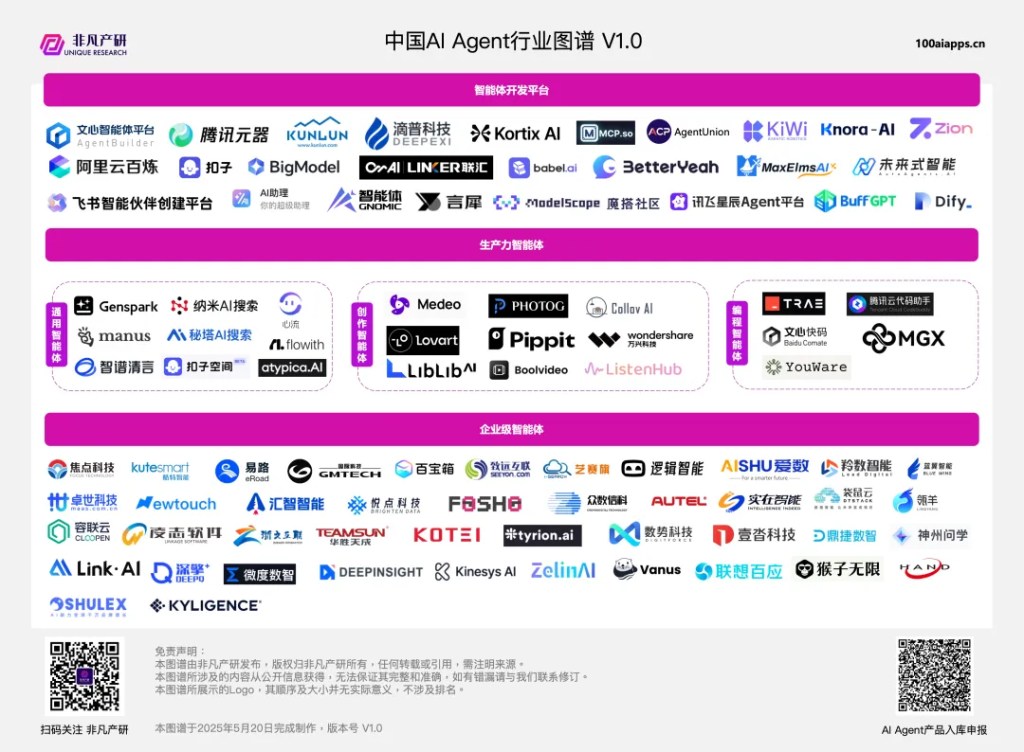
Facing this global wave, numerous companies and applications related to AI Agents have emerged like mushrooms after rain. To better organize and showcase the development status of China’s AI Agent industry, Extraordinary Industry Research has specially compiled and released the “China AI Agent Industry Map 1.0.”
Please note: The arrangement of logos in the map is only for layout design considerations and does not represent any ranking or market share; the AI Agent field is evolving rapidly, and we will continue to update the version. We welcome all new players to “report in”!
Let’s take a closer look at the unique structure of China’s AI Agent market within the map:
1. Intelligent Agent Development Platforms
From “Model Building” to “Intelligent Factory Construction” If large language models are the raw materials, then intelligent agent development platforms are the “intelligent factories” for producing Agents. Platforms such as Coze, MaxElmsAI, AutoAgents by FutureStyle Intelligence, and AgentUnion, which appear in our map, are creating “domestic alternatives” following the ideas of Microsoft’s MCP (Microsoft Copilot Platform) and NLWeb. They package complex capabilities such as underlying models, rich plugins, permission management, and long-chain planning, providing a convenient “one-click factory setup” experience. In the future, the company that can first achieve ultimate reliability and transparency in aspects such as security, billing models, and monitoring systems is likely to become the “Android” or “iOS” of China’s AI Agent ecosystem, serving as the underlying operating system that empowers various industries.
2. Productivity Intelligent Agents
The First Wave of Dividends from the Efficiency Revolution The improvement of productivity by AI Agents is immediate, which is the key to its initial outbreak.
General-purpose: “Super assistants” like Manus and GenSpark are dedicated to cross-domain information integration and automated execution. Manus, with its business model of charging based on the concurrent task volume, has just secured a $75 million Series B financing from Benchmark, and its valuation has soared to $500 million, which confirms the huge potential of the “selling results” business logic globally. On TikTok, you can see students using GenSpark to do their final reports and travel bloggers asking it to plan a 30-day European route. Packing “search + execution” into a single button is its greatest charm.
Creative: The popularity of Lovart and Collov AI in the fields of design and e-commerce image generation perfectly demonstrates the “chemical reaction” between AIGC (Artificial Intelligence Generated Content) and Agent orchestration. They can not only generate exquisite content but also automatically conduct competitor analysis and even place ads on your behalf. This is not just about generating images but generating “images that bring in sales,” greatly improving the efficiency and accuracy of content marketing.
Programming-oriented: Products such as ByteDance’s Trae and Wenxin Kuaima are quickly narrowing the gap between Chinese programmers and GitHub Copilot. These programming Agents can understand requirements, write code autonomously, refactor, and even assist in the 上线 process. In the future, the workflow of programmers will no longer be just typing on the keyboard but managing and orchestrating their own “programming Agent assembly lines,” allowing them to focus more on creative architecture design and solving complex problems.
3. Enterprise-level Intelligent Agents
The Earliest Battlefield for Profit Realization In the field of enterprise services, the promise of AI Agents to “sell results” has been most directly fulfilled. Teams such as Logic Intelligence, Tyrion.ai, and Shulex are deeply integrating Agent capabilities into enterprises’ core business systems such as ERP, CRM, and MES. Customers are no longer purchasing cold “API call times” but real “reduced inventory turnover days,” “compressed work order processing time,” “increased sales,” and other KPIs. This is precisely the early practice in China of the “paying for profit rather than licenses” model foreseen by Sequoia Capital. In the future, every enterprise department will have its own exclusive Agent, which will become the nerve endings of the enterprise’s efficient operation, perceiving, analyzing, making decisions, and executing autonomously in real time.
Why Can China’s Agent Market Achieve Its Own “Acceleration”?
1. Cost Reduction and Efficiency Enhancement through Open-source Models
Heavyweight models represented by DeepSeek-R1 and Qwen 3 adopt a strategy of “completely open-source + business-friendly agreements,” reducing the inference cost to the cent level while approaching the performance of closed-source flagship models on complex Agent task leaderboards. This means that domestic developers can obtain high-performance large language model bases at an extremely low cost, greatly reducing the development and deployment thresholds of Agents and accelerating innovation.
2. Advantages in the Deep Water Areas of Vertical Scenarios
Unlike the fierce competition in the To C subscription track in overseas markets, the Chinese market has earlier invested Agents in “hardcore” vertical scenarios such as manufacturing, retail, and government affairs. These scenarios usually have clear data loops and quantifiable ROI (Return on Investment), making them more suitable for the “selling results” business model. Enterprise users are more willing to pay for Agents that can bring clear business value.
3. Mature Overseas Expansion Channels
Taking Manus and Genspark as examples, Chinese teams have successfully achieved impressive ARR (Annual Recurring Revenue) in overseas markets, proving the feasibility of the model of “Chinese teams + overseas paying habits.” This path is being replicated by more domestic entrepreneurs, providing a broader market space and diversified business models for Chinese Agents.
What Will the Next Version of the Map Look Like?
The story of AI Agents has just begun, and Extraordinary Industry Research’s V1.0 map is just the starting point. In the future, we foresee that the industry will evolve in the following directions:
1. From “Solo Operations” to “Multi-intelligent Agent Collaboration”
In the future, 80% of the value will come from the orchestration across systems and departments. Companies that can turn the three core capabilities of “scheduling, memory, and permission” of Agents into standardized components are expected to own the operating system of future intelligent businesses. Your Agents will no longer be isolated individuals but will form an intelligent network to jointly solve more complex enterprise problems.
2. Deeply Vertical, Thin Horizontally
General-purpose assistant Agents may be responsible for the “last mile” of user interaction, while the real profits will be concentrated in the “deep water areas” of industry-specific Agents. For example, professional medical diagnosis Agents, complex tax declaration Agents, and precise supply chain planning Agents will create irreplaceable value by deeply embedding knowledge of vertical fields.
3. Popularization of the Outcome-as-a-Service (OaaS) Pricing Model
Whether it’s OCR recognition or Copilot assistance, the ultimate value will be aligned with the enterprise’s KPIs. Enterprises will increasingly prefer to pay for “results” rather than simply for API call times or licenses. This “result-oriented” pricing model will prompt Agent developers to pay more attention to the actual benefits of their products.
4. Double Insurance of Security and Ethics
As the permissions of AI Agents expand, data security, privacy protection, and ethical responsibilities will become core considerations. The company that can first build a solid defense system in aspects such as “security sandbox + authorization chain + trusted execution” will find it easier for its Agents to enter scenarios with extremely high compliance requirements, such as state-owned enterprises and financial institutions.
V1.0: A Lighthouse, Not the Destination
Standing at the watershed of 2025, Extraordinary Industry Research is well aware that the wave of AI Agents has just begun. Our V1.0 map is a lighthouse that illuminates the current landscape but is by no means the destination. We will update the map quarterly, closely tracking new models, new protocols, and new players. We also warmly welcome all developers, researchers, and investors to share their insights with us and “report in” together.
Our goal is simple: To dynamically present the most complete, reliable, and forward-looking AI Agent ecosystem map of China in front of you.
When software is rewritten by intelligent agents, we have every reason to believe that business rules will also be rewritten by profit formulas and efficiency curves. This is an exciting era, and let’s witness and participate in it together!
 Chinatimenow
Leave a comment