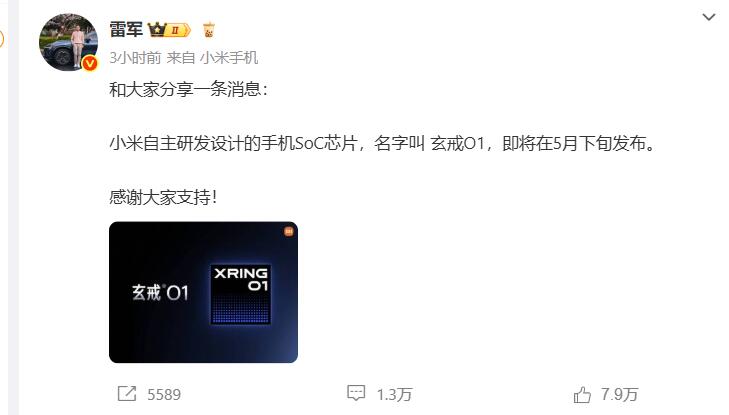
Xiaomi’s self-developed mobile phone chip is here! Lei Jun, the founder, chairman and CEO of Xiaomi Group, officially announced via social media that the self-developed mobile phone SoC chip named Xuanjie O1 will be released in late May. This marks Xiaomi’s official entry into the elite club of global mobile phone manufacturers with self-developed SoC chips, making it the fourth mobile phone brand in the world, following Apple, Samsung and Huawei, to have a self-developed mobile phone SoC. This not only represents a major breakthrough for Chinese tech companies on the road to chip autonomy, but also serves as one of the four catalysts for the rise of Xiaomi’s stock price. Investors can closely monitor the chip release at the end of May and Xiaomi’s stock performance thereafter.
Self-developed Chip Emerges, Xiaomi Officially Joins the “Chip-making Club”
On the evening of May 15, Lei Jun, the founder, chairman and CEO of Xiaomi Group, officially announced through social media: “I’d like to share a piece of news with you: Xiaomi’s self-developed and designed mobile phone SoC chip, named Xuanjie O1, will be released in late May. Thank you all for your support!”
This news indicates that Xiaomi has officially joined the elite club of global mobile phone manufacturers with self-developed SoC chips, becoming the fourth mobile phone brand in the world to have a self-developed mobile phone SoC, after Apple, Samsung and Huawei. According to Shanghai Securities News, following the launch of the first self-developed chip Pengpai S1 in 2017, this is Xiaomi’s release of a mobile phone main control chip again after an eight-year interval, demonstrating Xiaomi’s determination and achievements in continuous investment in the semiconductor field.
A Decade-long Road of Chip-making: From Pengpai S1 to Xuanjie O1
Xiaomi’s journey of self-developed chip began in October 2014, when Xiaomi established a wholly-owned subsidiary, Beijing Songguo Electronics, officially kicking off the research and development of mobile phone chips. In February 2017, Xiaomi released its first self-developed SoC chip, Pengpai S1, which adopted a 28nm process and was equipped on the Xiaomi 5C mobile phone, but received limited market response. Due to technical bottlenecks and supply chain issues, Pengpai S1 did not continue.
After that, it was rumored that the tape-out of Pengpai S2 failed, and the progress of the core system-level chip once slowed down. However, Xiaomi did not give up on chip research and development. Instead, it adjusted its strategy and started with special-purpose chips: in 2021, it launched the self-developed imaging chip Pengpai C1 and the charging management chip Pengpai P1, and in 2022, it launched the battery management chip Pengpai G1, gradually accumulating experience by introducing small chips.
According to Shanghai Securities News, the research and development team of Xuanjie O1 has a scale of over 1,000 people, operates independently of the main body of Xiaomi, and is led by Qin Muyun, a former senior executive of Qualcomm, with high-standard confidentiality and direct supervision from senior management. Previously, there were market rumors that Xiaomi had established a Chip Platform Department under the organizational structure of the Mobile Phone Department Product Department and appointed Qin Muyun as the person in charge.
SoC Chip: The “Brain” and “Nerve Center” of Mobile Phones
The SoC (System on Chip) chip is the core component that determines the performance of mobile phones. According to the description of Securities Times, it is like a “miniature city”, integrating multiple functional modules such as CPU (Central Processing Unit), GPU (Graphics Processing Unit), DSP (Digital Signal Processor), RAM (Random Access Memory), Modem (Modulator-Demodulator) and navigation and positioning modules, enabling mobile phones to achieve rich functions within a limited volume.
Wang Peng, an associate researcher at the Beijing Academy of Social Sciences, told Securities Times: “Self-developed chips can better meet the performance and unique technical advantages required by mobile phone manufacturers, enhancing the competitiveness of mobile phones. At the same time, it also enables mobile phone manufacturers to reduce their dependence on the supply chain and provide them with stronger control over the supply chain.”
Xuanjie Technology Company Behind “Xuanjie O1”
The name of the Xuanjie O1 chip comes from its R&D entity company. According to Qichacha data, Beijing Xuanjie Technology Co., Ltd. was established on October 26, 2023, with a registered capital of 3 billion yuan, and Zeng Xuezhong serves as the executive director.
Zeng Xuezhong joined Xiaomi Group in 2020 and has been responsible for the research, development and production of mobile phone products. He currently serves as the Senior Vice President of Xiaomi Group and President of the International Business Department, in charge of the Internet Business Department. He has rich experience in the communication and chip industries. He once served as the Senior Vice President and President of China Region of ZTE Corporation, Executive Vice President and CEO of ZTE Terminal, as well as the Global Executive Vice President of Unisplendour Group Co., Ltd., President of Unisplendour Corporation and CEO of Unisoc. He is also the Vice Chairman of the China Integrated Circuit Design Industry Technology Innovation Strategic Alliance.
According to Qichacha data, since 2025, Beijing Xuanjie has intensively applied for publicly disclosed invention patents related to chips. On Tuesday, May 13 alone, the company applied for 10 publicly disclosed invention patents, including the “Chip Packaging Method, Chip Packaging Structure and Electronic Device”. Currently, the company has 115 publicly disclosed patents, covering categories such as telecommunication technology, basic electrical components and basic electronic circuits, and 113 of these patents are under review.
Catalysts for Xiaomi’s Stock Price: Four Favorable Factors
Analyst Bin Wang of Deutsche Bank stated in the latest research report that the pullback in Xiaomi’s stock price provides a good buying opportunity for investors. The report believes that there are four key catalysts in the next two months that may drive the rebound of Xiaomi’s stock price, and the self-developed mobile phone chip is one of them. The four positive factors for the stock price are as follows:
First Quarter 2025 Earnings Report: Deutsche Bank expects Xiaomi’s sales in the first quarter of 2025 to increase by 9% year-on-year, reaching 758,690 units. The gross profit margin of smart electric vehicles and new businesses will increase to 22% quarter-on-quarter. The total revenue in the first quarter is approximately 109 billion yuan, and the adjusted net profit is 10 billion yuan (an increase of 54% year-on-year and 20% quarter-on-quarter).
Release of Self-developed Mobile Phone Chip: According to DigiTimes, Xiaomi is expected to launch its self-developed smartphone chipset (codenamed XRING, namely the confirmed “Xuanjie O1”) at the end of May.
Investor Day Event: Xiaomi plans to hold a “2025 Investor Day” meeting on June 3, followed by a visit to the smart electric vehicle factory in Beijing from June 4 to 5.
Release of “YU7” SUV: Xiaomi’s second model, the “YU7” electric SUV, will be released in June or July. Deutsche Bank predicts that its monthly sales will reach approximately 30,000 units.
China’s Semiconductor Industry Chain Further Moves Towards Autonomy and Controllability
Industry experts believe that the release of Xuanjie O1 is a phased achievement of China’s semiconductor industry chain towards autonomy and controllability. If it is successfully mass-produced, it will help domestic mobile phone manufacturers reduce their dependence on suppliers such as Qualcomm and may inspire more enterprises to join the chip research and development.

People’s Daily highly praised the significance of Xiaomi’s self-developed chip this Wednesday, stating that “In the past year, Xiaomi has made successive breakthroughs and innovations in fields such as new energy vehicles and domestic chips. This proves that as long as we are determined and practical, there are no insurmountable mountains; as long as we strive to catch up, latecomers always have the opportunity.”
People’s Daily pointed out: “Currently, the vitality of the private economy is continuously released, and more and more private enterprises are shouldering heavy responsibilities and pioneering new paths in scientific and technological innovation and industrial innovation. Opening up unfamiliar fields will inevitably bring new problems and challenges, and exploring unknown boundaries will inevitably encounter misunderstandings and doubts. In the midst of all this, the key is to focus with a calm mind, cultivate oneself and persevere, face the problems in development with a developmental perspective, and solve the problems in development with developmental methods.”
Xiaomi’s 2024 financial report shows that its R&D investment continues to increase. The annual R&D expenditure is 24.1 billion yuan, a year-on-year increase of 25.9%. R&D personnel account for 48.5%. Technological breakthroughs include the self-developed super motor V8s, the Pengpai OS 2 system and intelligent driving technology. It has over 42,000 authorized patents globally, of which more than 1,000 are related to automobiles.
There are market rumors that the Xiaomi 15S Pro will be the first to be equipped with Xiaomi’s self-developed SoC chip and will also be equipped with UWB technology, enabling deep linkage with Xiaomi cars (such as SU7/YU7). Subsequent Xiaomi models will gradually be equipped with the Xuanjie series chips, and in the future, it may be extended to the fields of automotive intelligent cockpits and IoT devices.
As the “Xuanjie O1” is about to be unveiled, investors and the tech community will closely monitor the specific specifications and market performance of this highly anticipated chip product. This is not only related to Xiaomi’s future technical route and product competitiveness, but also further tests the R&D strength of Chinese enterprises in the field of high-end chips.
 Chinatimenow
Leave a comment