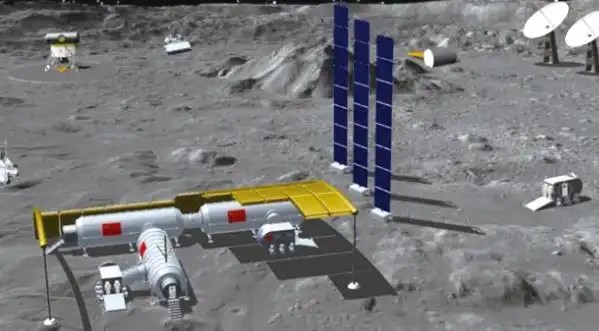
There is another major piece of news regarding Sino-Russian lunar cooperation.
According to Interfax on May 12, the Russian State Space Corporation (Roscosmos) and the China National Space Administration (CNSA) signed a memorandum of cooperation on building a lunar nuclear power plant on the 8th.
The Russian State Space Corporation stated in a statement that the power station will make a significant contribution to the International Lunar Research Station (ILRS) project led by China and Russia, and the research station is expected to be completed in 2036. The statement also said, “The station will conduct basic space research and test the long-term unmanned operation technology of the ILRS, looking forward to the presence of humans on the Moon.”
Previously, Wu Weiren, Chief Designer of China’s Lunar Exploration Project, told Reuters in April, “An important issue faced by the International Lunar Research Station is power supply, and Russia has a natural advantage in this regard. In terms of nuclear power plants, especially in sending them into space, Russia is leading the world, ahead of the United States.”
Wu Weiren also said that the negotiations between the two countries on space reactors in the past have made little progress. “I hope that this time the two countries will be able to send a nuclear reactor to the Moon.”
Pei Zhaoyu, Chief Engineer of the Chang’e-8 mission in 2028, added that the energy supply for the lunar base can also rely on large-scale solar cell arrays built on the lunar surface, as well as heating, power supply pipelines and cables.
It is worth noting that as early as last year, the Russian State Space Corporation revealed that it was considering cooperation with China to build a nuclear power plant on the Moon between 2033 and 2035.
Yuri Borisov, President of the Russian State Space Corporation, said at that time, “We are seriously considering a project – between about 2033 and 2035 – to transport and install a power unit on the lunar surface together with our Chinese counterparts.” Borisov said, “Solar panels cannot provide sufficient power for future lunar settlements, while nuclear energy can.”
According to previous reports, in July 2020, the space agencies of China and Russia determined the cooperation on the International Lunar Research Station; in March 2021, the governments of China and Russia signed the “Memorandum of Understanding on Cooperation in Building the International Lunar Research Station”, launching the cooperation on the International Lunar Research Station. In April of the same year, the “Joint Statement of the China National Space Administration and the Russian State Space Corporation on Cooperation in Building the International Lunar Research Station” was released, demonstrating the confidence and determination of China and Russia in cooperation in the lunar and deep space fields.
In accordance with the principle of “overall planning, step-by-step implementation, and use while building”, the International Lunar Research Station will be implemented in three stages. It is planned to complete the basic model by 2028, carrying out lunar environmental exploration and resource utilization test verification. By 2040, the improved model will be completed, carrying out scientific experiments on the space environment of the Sun, Earth and Moon, and building the Magpie Bridge communication, navigation and remote sensing integrated constellation to serve manned lunar landing and deep space exploration of Mars, Venus, etc. After that, an applied lunar research station will be built, gradually upgrading from a research-type experimental station to a practical and multi-functional lunar base.
The National Space Administration previously introduced that China and Russia will jointly build the International Lunar Research Station together with other international partners. The International Lunar Research Station will be another new and important contribution made by China and Russia to promoting the long-term sustainable development of United Nations outer space activities. The China National Space Administration and the Russian State Space Corporation adhere to the principle of “extensive consultation, joint contribution and shared benefits” to promote extensive cooperation on the International Lunar Research Station and jointly promote the development of human space science and technology and economic and social progress.

 Chinatimenow
Leave a comment