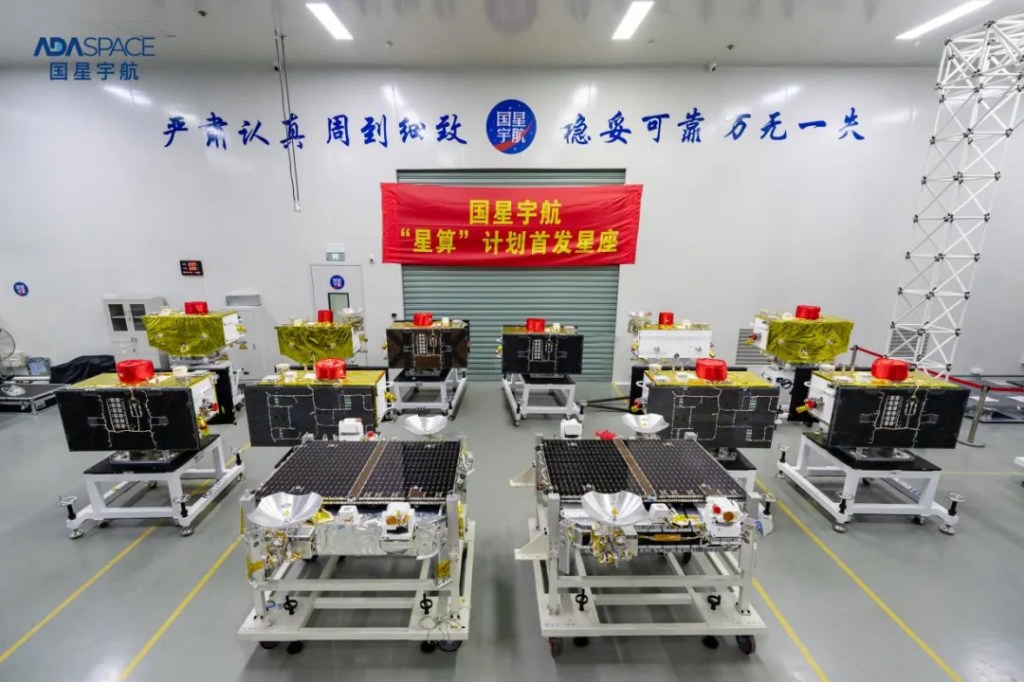
At 12:12:00 Beijing time on May 14, 2025, Guoxing Aerospace successfully launched 12 satellites of the 021 mission of the space computing constellation using a Long March 2D carrier rocket at the Jiuquan Satellite Launch Center. The satellites smoothly entered the preset orbit, marking the successful launch of the world’s first space computing constellation.
The successful launch of the first constellation mission has opened a new chapter in the global “space computing era”.
The 021 mission of the space computing constellation is the first constellation of the “Star Computing” plan initiated by Guoxing Aerospace, and also the first constellation of the “Three-Body Computing Constellation” of the Zhijiang Laboratory. The constellation is composed of 12 computing satellites in one orbit developed by Guoxing Aerospace, namely Neijiang No. (Star Era-27), Neijiang High-tech No. (Star Era-28), Taizhou No. (Star Era-29), Haikou No. (Star Era-30), Ma’anshan Zhisuan No.1 (Star Era-31), Chongzhou No. (Star Era-32), Tiantie Technology No. (Star Era-33), Miyanyouliangyuan No. (Star Era-34), Yukongzhe No. (Star Era-35), “Dalinghao Bay” Star (Star Era-36), Zhijiang No.1 (Star Era-37), and Zhijiang No.2 (Star Era-38).
“Artificial intelligence should not be absent from space due to the lack of computing power.” Wang Jian, an academician of the Chinese Academy of Engineering and the director of the Zhijiang Laboratory, said that the construction of the space computing constellation can make a single satellite play a greater value, which has far-reaching significance for the transformation of the space industry.
The 12 computing satellites of the first constellation adopt the intelligent networked satellite platform independently developed by Guoxing Aerospace. In addition to being equipped with the self-developed AI payload of Guoxing Aerospace, they also carry the on-board intelligent computer of the Zhijiang Laboratory, on-board high-speed router, inter-satellite laser communication machine, space-based distributed operating system, space-based remote sensing model and other payloads and software, realizing “computing power in space and networking in orbit”. Each satellite is equipped with an on-board intelligent computing system and inter-satellite communication system, with space computing and space interconnection capabilities. The on-orbit computing power of the first constellation reaches 5 POPS (4 POPS for the on-board intelligent computer and 1 POPS for the AI payload), and the inter-satellite laser communication rate can reach up to 100 Gbps.
In addition to computing and interconnection capabilities, the satellites of the first constellation are also equipped with earth observation remote sensing payloads. With the help of on-board computing power, real-time on-orbit data processing can be achieved, exploring and verifying “space computing”. By effectively reducing data transmission costs and time delays, the data processing efficiency is improved. At the same time, through the satellite virtual environment engine, it can provide satellite three-dimensional digital twin data and application services for industries such as emergency safety, low-altitude economy, embodied intelligence, and game culture and tourism.
The satellites launched this time are also equipped with cosmic X-ray polarization detectors developed by Guangxi University and the National Astronomical Observatories of the Chinese Academy of Sciences. Through the space-based astronomical time-domain model, they can quickly detect, identify and classify various transient sources such as gamma-ray bursts on orbit, and trigger coordinated observations by two satellites, achieving second-level judgment and a recognition accuracy rate of 99%. It promotes the transformation of the paradigm of space scientific research with “artificial intelligence +”.
Wang Jianyu, an academician of the Chinese Academy of Sciences and the president of the Hangzhou Institute for Advanced Study, University of Chinese Academy of Sciences, said that as the networking of giant constellations becomes a global aerospace development trend, the traditional mode of “issuing commands from the ground to the satellite, the satellite executing, and transmitting back to the ground” faces challenges, and a large number of on-board autonomous decision-making and operation systems are required, which puts forward new requirements for space computing. Intelligent networked satellites can achieve on-orbit autonomous collection, analysis and decision-making, greatly improving the quality, efficiency and space of satellite data application.
Guoxing Aerospace will continue to take independent innovation as the core, work hand in hand with global partners to build an intelligent and interconnected space computing ecosystem, accelerate the networking construction process of the space computing constellation of the “Star Computing” plan, give full play to the advantages and characteristics of the space-based computing infrastructure, which has global coverage, mobile ubiquity, green and low-carbon features, and actively carry out international cooperation.
 Chinatimenow
Leave a comment