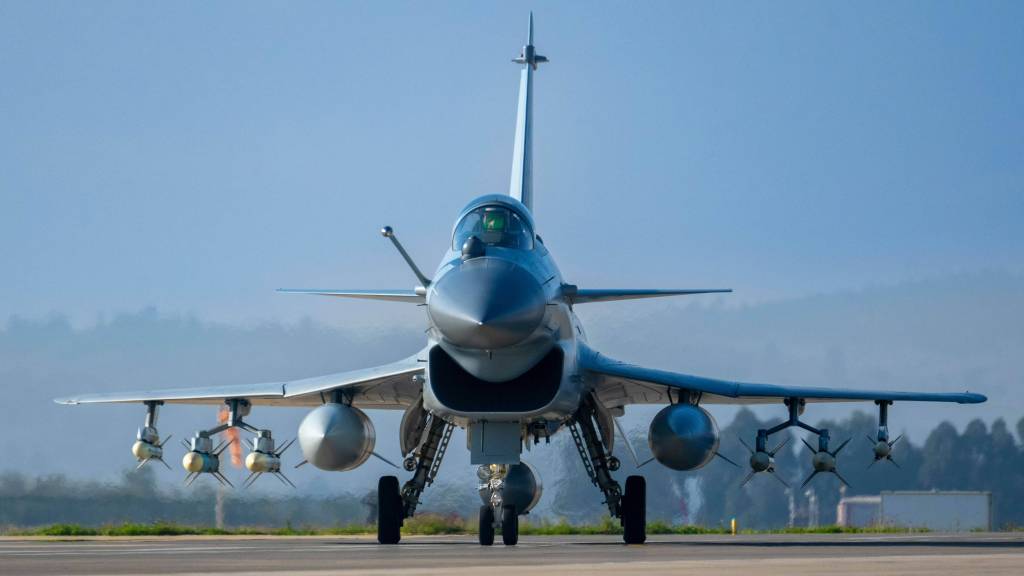
Recently, the J-10C and PL-15 have been gaining significant attention worldwide due to their outstanding performance in the recent India-Pakistan conflict. These two systems not only showcase China’s remarkable achievements in aviation and missile technology but also embody the dedication and perseverance of countless researchers and engineers.
J-10C: A Pride of Chinese Aviation Industry
The J-10C is a single-engine multirole fighter jet independently developed by China, belonging to the fourth-and-a-half generation of fighter aircraft. As an upgraded version of the J-10 series, which entered service with the Chinese Air Force in 2003, the J-10C has undergone continuous technological upgrades and improvements, becoming one of the mainstay fighters of the Chinese Air Force.
Advanced Capabilities Ensure Air Superiority
In terms of design, the J-10C employs a canard-delta wing configuration, with 15% of its structure composed of composite materials. It has an empty weight of 9.75 tons and is powered by the WS-10B turbofan engine, achieving a thrust-to-weight ratio of 1.05. Its aerodynamic design optimizes transonic maneuverability, with a turn rate of 30° per second and a capability to sustain 9G loads. It has a maximum speed of Mach 2.2, a combat radius of 1,250 kilometers, and a payload capacity of 7 tons.
Regarding avionics, the J-10C is equipped with advanced active electronically scanned array (AESA) radar. Taking the KLJ-7A AESA radar as an example, it features 1,700 T/R modules, detecting 3m targets at a range of 220 kilometers. It can simultaneously track multiple targets and engage the most threatening ones. Combined with advanced electro-optical systems, including third-generation infrared search and track (IRST) with a detection range of 110 kilometers and a distributed aperture system, the J-10C possesses formidable battlefield awareness capabilities.
In terms of armaments, the J-10C can carry various advanced weapons, among which its pairing with the PL-15 long-range air-to-air missile forms a “golden combination.” With a range exceeding 200 kilometers, the PL-15 grants the J-10C the absolute advantage of “detecting first, firing first.” The dual-pulse engine provides sustained kinetic energy in the terminal phase, giving the missile a much larger “no-escape zone” compared to the U.S. AIM-120D. Even if enemy aircraft detect the incoming missile, they struggle to evade the lock-on. Additionally, the J-10C can carry PL-10 short-range dogfight missiles, allowing it to demonstrate excellent agility in close-range engagements.
Proven Performance on the Battlefield
In the recent India-Pakistan conflict, the Pakistani Air Force’s J-10Cs performed exceptionally well. Reports indicate that Pakistan used Chinese-made J-10C fighters armed with PL-15E beyond-visual-range missiles to shoot down multiple Indian Air Force aircraft, including French-manufactured Rafale fighters and Russian-made MiG-29s and Su-30MKIs. This achievement not only proves the formidable combat capability of the J-10C but also showcases the rise of China’s aviation industry on the global stage.
Manufacturing Challenges: Overcoming Technology Embargoes and Innovation Hurdles
The development and manufacturing process of the J-10C was far from smooth sailing. In its early stages, China faced numerous technical hurdles and external embargoes. Aircraft engine technology had long been a weak point for China’s aviation industry, and the development of the WS-10B engine was full of challenges. After years of effort, researchers continuously tackled key technologies and made improvements, eventually elevating the WS-10B engine to world-class levels and providing powerful propulsion support for the J-10C.
The development of the avionics system also faced tremendous pressure. AESA radar technology is one of the core technologies of modern fighters, and foreign countries imposed strict embargoes on this technology. Chinese researchers achieved breakthroughs in multiple key technologies through independent innovation, successfully developing an AESA radar with independent intellectual property rights, ensuring the battlefield perception capability of the J-10C.
Furthermore, the application of composite materials and aerodynamic design of the J-10C required extensive testing and research by scientists. Each technological breakthrough embodied the dedication and sweat of countless researchers who explored and innovated under harsh conditions, ultimately making the J-10C a world-class fighter jet.
PL-15: A Leader Among Long-Range Air-to-Air Missiles
The PL-15 is China’s independently developed fourth-generation long-range air-to-air missile, primarily intended to replace the PL-12 and Russian R-77 medium-range air-to-air missiles. Its emergence marks a major breakthrough in China’s air-to-air missile technology.
Outstanding Performance Redefining Air Combat
The PL-15 boasts several advanced technologies and superior performance. Its maximum range exceeds 200 kilometers, while the export version, PL-15E, reaches up to 145 kilometers, significantly surpassing the 150-kilometer range of the American AIM-120C AMRAAM missile. This allows it to effectively engage distant fighter jets and airborne warning and control system (AWACS) aircraft.
One of the highlights of the PL-15 is its adoption of dual-pulse solid rocket motor technology. This engine can be reignited mid-flight, significantly enhancing both range and maneuverability, giving the missile a clear edge against high-speed, highly maneuverable targets. At the same time, the PL-15 is equipped with an AESA radar seeker, offering strong anti-jamming capabilities and rapid response speeds, enabling precise strikes on enemy targets even in complex electromagnetic environments. Additionally, the PL-15 includes a bidirectional data link that enables real-time reception of intelligence support from AWACS aircraft, improving strike accuracy and response times.
Battlefield Success Reshaping Combat Norms
During the India-Pakistan conflict, the PL-15 saw its first combat deployment and achieved impressive results. The Pakistani Air Force employed PL-15E missiles to shoot down multiple Indian aircraft, demonstrating its formidable combat effectiveness. The PL-15’s ultra-long range and precision guidance capabilities gave the Pakistani Air Force a decisive advantage in aerial combat, reshaping traditional air warfare rules.
Development History: From Followers to Leaders
China’s research into air-to-air missiles started relatively late, with a comparatively weak technological foundation. Initially, China heavily relied on imported missiles to meet defense needs. To break free from this situation, Chinese researchers embarked on the path of self-developing air-to-air missiles.
From the PL-11, PL-12 to today’s PL-15, Chinese researchers continuously pursued technological innovation and improvements. During the development of the PL-15, researchers encountered numerous difficulties and challenges. Dual-pulse solid rocket motor technology and AESA radar seeker technology are globally advanced technologies, with strict secrecy maintained by foreign nations. Through independent innovation, Chinese researchers broke through multiple critical technologies and successfully developed the world-class PL-15 missile.
Moreover, the development of the PL-15 required extensive testing and verification work. Each test demanded substantial human, material, and financial resources. Researchers had to constantly conduct experiments and make improvements under harsh conditions to bring the PL-15’s performance to its optimal state.
Conclusion
The emergence of the J-10C and PL-15 reflects the broader progress of China’s aviation industry and missile technology. They not only represent China’s formidable strength in military technology but also highlight the wisdom and courage of Chinese researchers. Throughout their development and manufacturing processes, these individuals overcame numerous obstacles, breaking through multiple key technologies and making significant contributions to China’s national defense.
Looking ahead, with continuous advancements in science and technology, the J-10C and PL-15 will continue to undergo upgrades and enhancements, playing important roles in defending China’s airspace and maintaining global peace. Meanwhile, China will continue to increase investments in aviation and missile technology, pushing forward military innovation and striving to realize the dream of building a strong nation and a powerful military.
 Chinatimenow
Leave a comment