
On May 2, 2025, at 08:30, from Shangguan News
In the world’s first humanoid robot half-marathon, 20 robot teams and tens of thousands of human runners competed on the same field. In the end, “Tiangong Ultra” developed by the Beijing Humanoid Robot Innovation Center won the first place in the competition with a time of 2 hours, 40 minutes and 42 seconds.
Runners Jia Ning and Liang Jiwei stood on the starting line with the same number bib (60901) as “Tiangong Ultra”. Jia Ning served as the pacemaker, and Liang Jiwei served as the escort runner for “Tiangong Ultra”.
At the present stage, humanoid robots are still unable to run independently. Unlike many participating teams that remotely control the robots with engineers, for most of the 21-kilometer course, “Tiangong Ultra” adopted a semi-autonomous navigation leading mode. That is, a pacemaker carried a transmitter and led the way in front, and “Tiangong Ultra” used sensors to detect the movement state of the pacemaker and planned its own route.
During the preliminary training and running-in period, Jia Ning found that leading a robot to run was quite different from his usual running. He had to maintain a stable state as much as possible and had a smaller stride.
The whole humanoid robot half-marathon was not all smooth sailing. Among the 20 participating teams, only 6 teams completed the race, including the Tiangong Team, Songyan Dynamics Xiaowantong Team, Xingzhe No. 2 Team, Songyan Dynamics Xuanfeng Xiaozai Team, EAI, and Banxing Robot Team. A week after the race, the discussion about this humanoid robot marathon has not subsided. Pictures of robots with various shapes running, waving, and falling down have been continuously forwarded and commented on the Internet. Some people cheer for the huge leap in technology, while others complain that the performance is not as good as expected.
Pacemaker Jia Ning has also read a lot of discussions about the robot marathon. Although he is an outsider in the field of embodied intelligence, he believes that it is a great progress in itself to put the robot in a real environment for practice.
On the day of the official race, escort runner Liang Jiwei only wore a pair of ordinary jogging shoes. He knew that the pace of “Tiangong Ultra” would not be particularly fast. When they ran to more than 16 kilometers, before reaching the next supply point, “Tiangong Ultra” fell down without warning. Liang Jiwei did not dare to act rashly and could only wait for the engineer’s arrangement. Fortunately, after replacing the battery, the robot returned to normal and started running again after the fall. Liang Jiwei said that he had been cheering for the robot in his heart, and at that moment, it seemed that it was no longer just a machine.
The following are the accounts of Jia Ning and Liang Jiwei:
Pacemaker Jia Ning: “Stability” is the Key to Navigating the Robot
I started running in 2017 and have participated in more than 30 marathons. My personal best time for a half-marathon is 1 hour and 30 minutes, and my personal best time for a full marathon is 2 hours and 56 minutes.
More than a month before the official start of the humanoid robot half-marathon in Yizhuang, I became the pacemaker of “Tiangong Ultra” through the introduction of a friend.
At first, when I received this task, I wasn’t sure if I could handle it, but I was very curious about the idea of a robot running. Although I had seen robots dancing on the Spring Festival Gala, I had never had any contact with robots. In my impression, robots all had wheels.
The first time I saw the 1.8-meter-tall “Tiangong Ultra” in person, I was a bit surprised that it could walk steadily. At that time, we hadn’t tried running yet, and I wondered if it would run very fast.
At that time, I didn’t quite understand why we needed a pacemaker. Wouldn’t it be faster to follow a car? Later, the engineer explained that after all, a humanoid robot is designed to imitate humans.
The task of the pacemaker is to always stay 3-5 meters in front of “Tiangong Ultra” and navigate through a special signal transmitter. At first, five runners took turns wearing the transmitter and tested it in rotation to see whose gait would be more stable. If the person shakes, the robot will also shake.
We don’t need to know too many technical details. The engineer will tell us how fast the robot can run and what pace we should run at.
At the beginning, when the teachers from Tiangong demonstrated, I thought, what’s so difficult about this? It’s just about carrying a transmitter and leading the robot to run, and at most, the speed is a bit slower. Later, I gradually felt the arduousness of this task. The cooperation between humans and robots was not as perfect as I had imagined.
When running by myself, I would definitely run in the most comfortable way. When trying to increase the speed, my body would lean forward. Since the robot needs to recognize my posture, it won’t work if my body swings left and right. I need to keep my waist stable, and my stride can’t be too large. It’s still mainly about stability. My pace is about “410” (4 minutes and 10 seconds per kilometer), and the pace of Tiangong is “730” (7 minutes and 30 seconds per kilometer). So when leading the run, I have to hold back my speed.
In the past month or so, I haven’t practiced running much. I just maintain my condition occasionally. I don’t dare to practice too much, for fear that I might get too excited on the race field and just dash out as soon as I lift my leg.
Before the official race, in some closed sections, we ran in with the robot for about seven or eight times in total.
Due to the strong wind in Beijing, the race was postponed to April 19. The night before the race, I was so excited that I couldn’t fall asleep.
During the race, many runner friends greeted me, but in order to maintain the balance of the robot behind me, I didn’t turn my head to respond much.
There were also many spectators cheering for the robots by the track. Sometimes I could hear their conversations. Many people brought their children specifically to watch the humanoid robot race. Among the human runners on the separated track, some even started a live broadcast and introduced while running that they were running behind the first-place robot.
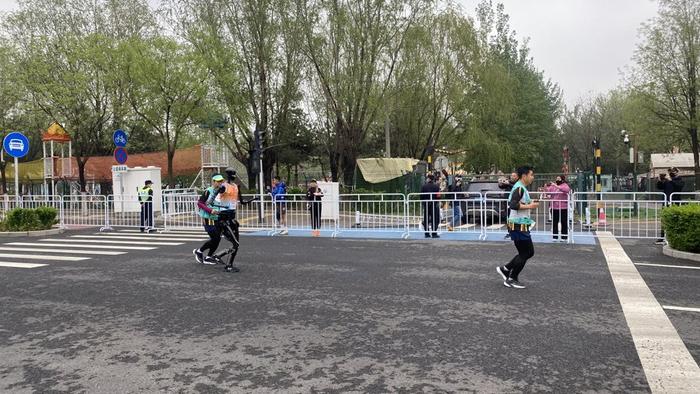
The moment when Jia Ning was leading the run was captured by a fellow runner. Photo provided by the interviewee.
I held a walkie-talkie throughout the whole process and communicated with escort runner Brother Liang and the staff on the support vehicle in real-time about the situation. For example, when there was going to be a left turn ahead, I would say it in advance, or if the road was uneven, I would remind them to pay attention to the robot’s condition. The most important thing was to avoid it falling down.
Our temporarily formed team not only had to run in with the robot but also had to run in among ourselves. To maintain the distance between me and the robot, it also relied on team cooperation. If it was too close or too far, the escort runner behind would remind me. When it was too close, I could hear the “dong dong dong” sound of the robot’s footsteps and the sound of its joints moving. When I couldn’t hear the sound behind clearly, I had to constantly ask them how I was running. As long as I got the reply of “OK” or “Keep it up”, I knew it was fine.
When we reached more than 16 kilometers, the escort runner told me through the walkie-talkie that the robot had fallen down. I couldn’t turn around to see what had happened. I didn’t turn around and go over until the people on the support vehicle said “stop”.
As an escort runner and a pacemaker, we try not to touch the robot as much as possible because there are technicians around. Our responsibility is to provide support beside it.
A spare robot was pulled down from the support vehicle. Once replacing the battery didn’t work, the spare robot would be activated. However, after replacing the new battery, the original robot continued to run. This was the third time that “Tiangong Ultra” had its battery replaced during the race. The previous two times were at 5 kilometers and 10 kilometers respectively.
For most of the time during the race, the robot’s turning and pace were following me. But at the starting point and the finishing point, it was still controlled by the engineer. When there were still one or two hundred meters to the final finish line, the robot was taken over by the engineer. We had to ensure that the robot crossed the finish line first, and we followed behind.
After crossing the finish line, it stopped at the finish point for a while. Many media were taking photos. I was also very relieved in my heart. The robot didn’t have any malfunctions, and I had completed my task. Looking back at the live broadcast of the race, I found that my expression was very serious, not the relaxed state I usually had when running. I was a bit nervous.
I work in office equipment maintenance, and my time is relatively flexible, so I was able to take on this task of being a pacemaker. Robots are neither within my previous work scope nor within my area of interest. But after this race, I’m thinking whether humanoid robots can really enter the field of marathons. There are “rabbits” (pacemakers) in marathons. Maybe in the future, there will be robot “rabbits”. Now I’m leading the robot to run, and in the future, it may be the robot leading humans to run.
(Reporter’s note: “Rabbit” is the common term for a marathon pacemaker. They usually wear unified clothing and carry obvious signs, and lead runners of the same speed segment to run at a stable pace. Usually, they have high requirements for the runner’s speed control ability, rhythm ability, and competition experience.)

After the race, Jia Ning took a group photo with “Tiangong Ultra”. Photo provided by the interviewee.
Escort Runner Liang Jiwei: Being an Escort Runner for a Robot is More Tiring than Running Myself
During the race, the division of labor between Jia Ning and me was that he led the robot to run in the front, and I protected the robot in the rear. Leading the run and remote control are two different concepts. Once we receive the message in the walkie-talkie that “the pacemaker is navigating”, it means that the pacemaker in front takes over, and the engineer doesn’t need to remotely control it.
The day before the race, it rained in Beijing, and the road surface was quite slippery. I had to focus my attention on the robot throughout the whole process. Being an escort runner for a robot is more tiring for me than running myself, and this tiredness is not physical but psychological.
Before the official start of the race, there was a 5-kilometer qualifying race on April 9. I was even more nervous than when I ran a race myself. The result of the qualifying race would affect the starting order of each team in the official humanoid robot half-marathon. I especially didn’t want any accidents to occur due to my own reasons or insufficient preparation, which would affect the result of the qualifying race.
The qualifying race started after 11 pm, and the light was very dim. The flashing lights of the cameras by the field and the reflection of some metal parts on the robot made my eyes very uncomfortable, but I still had to stay focused.
After running more than 2 kilometers, the robot suddenly fell down. The reporters by the field immediately gathered around. I was very anxious and almost instinctively pulled the more than 100-jin robot up from the ground. Later, I also wondered how I managed to do it at that time. In the 5-kilometer qualifying race, Tiangong won the first place.
Later, the engineer repeatedly emphasized that during the official race, don’t just pick up the robot immediately like in the qualifying race when it falls down. In case it can’t be picked up and other parts are damaged by knocking, there will be greater losses.
When the robot really fell down between 16.5 and 16.7 kilometers during the official race, I wasn’t as flustered as I was in the qualifying race. All the joints of the robot need electricity to maintain. Once the power is cut off, it will fall down instantly like a pile of soft mud. However, after replacing the battery, it returned to normal, and we continued without replacing the robot.
Before 16 kilometers, the pace of Tiangong was between 6 minutes and 30 seconds and 7 minutes per kilometer. After falling down, the running speed of the robot decreased, and it was above 7 minutes and 15 seconds per kilometer.
Many people saw me in the live broadcast and didn’t understand what an escort runner does, or they thought that I was holding the robot and running throughout the whole process. In fact, my hand hardly touched the robot. I just held it up and made some protective gestures. At some turning points, such as manhole covers, I prevented the robot from falling down. If the robot’s body shook a bit and its gait was unsteady, I would gently support it.
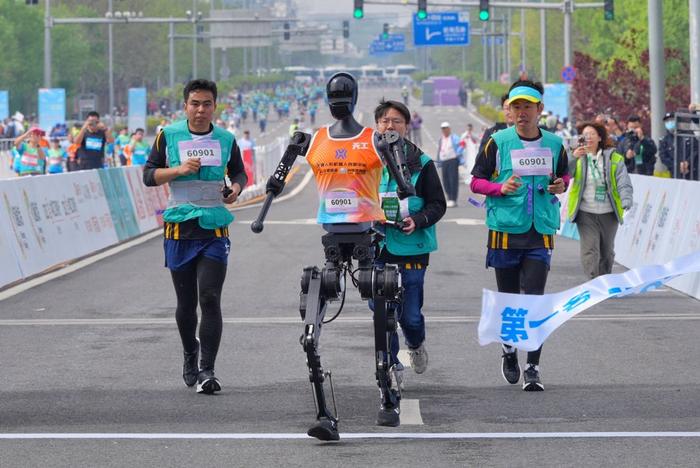
At the finish line, Liang Jiwei (on the right) was behind “Tiangong Ultra”.
After starting to run again, I didn’t dare to keep my hand too far away from the robot. My hand that had been raised for a long time was already sore, but I still tried to keep it close, for fear that if it fell down, it would cause unnecessary damage or a series of consequences such as time penalties for replacing the robot.
Many spectators by the track were cheering for the robot, and I was also cheering for it in my heart. At that time, I no longer regarded it as just a machine but as a friend. I really hoped that it could complete the race smoothly.
During our previous running-in training, sometimes the engineer also joked that it “was in a bad mood today”, and it would run in an “S” shape and run horizontally.
The final result of the half-marathon, 2 hours, 40 minutes and 42 seconds, was within our expectations. If there hadn’t been that fall, it would have been quite satisfactory.
I work in market research and originally knew nothing about robots, especially humanoid robots. When I really saw Tiangong and saw it walking and running, and heard the “guang dang guang dang” sound beside me, and saw it running with its two legs supporting and alternating, I felt that it was really not easy.
As a runner, I think the running rhythm of the robot is very good. Although the announced speed of Tiangong is 12 kilometers per hour, in my eyes, its speed should be much higher than this value. Different from humans, as long as the joint parts of the robot are not damaged, its rhythm will always be the same.
After the race, my social network was filled with information about the humanoid robot half-marathon, and I also heard some voices of doubt. I think robots may be just like cars at the beginning. When cars were first invented, they were even slower than carriages. Who could have imagined that the speed of cars could be so fast now?
In my opinion, the humanoid robot half-marathon is not only a platform for marathon races but also a platform for robots to compete. Among the 20 participating teams, some are competing in the stability of their batteries, some in the flexibility of their joints, some in speed, and some in optimizing algorithms. These are all healthy competitions, and only through competition can there be growth. It’s just like when we run marathons. Among friends, the relationship is very good, but we often compete fiercely with each other. I want to overtake you, and you want to overtake me. Only in this way can we move forward together and improve our performance.
Now that robots can run a half-marathon, they may be able to run a full marathon in the near future. The current running speed of humans in marathons is 20 kilometers per hour, and the speed of robots can reach 12 kilometers per hour. With the development of technology, it’s only a matter of time before robots surpass humans.
In the past week, I have read a lot of news about robots and also noticed a detail in the “growth diary” of “Tiangong” – in January this year, it took Tiangong 8 hours to finish a half-marathon. At that time, it still had to be tied to a crane with a rope at one end, and the engineer controlled its movement direction with a remote control.
In just three months, the time of 8 hours was shortened to 2 hours, 40 minutes and 42 seconds. It has really developed very fast. From the first time I came into contact with it to the time I participated in the race, in just over a month, I could also feel its rapid growth.
At present, the application scenarios of humanoid robots have not reached a very diversified state. I think it is still in its initial stage. Once it can help humans complete more scenarios, it will develop even faster.
 Chinatimenow
Leave a comment