
Actress Liu Meihan Faces Backlash for Fake Goods at Second – Hand Market
Recently, the topic of “Liu Meihan selling fake goods at her idle market” has sparked heated discussions among netizens1.
Liu Meihan’s “Idle Circulation Plan” was held from April 25th to 27th1. It invited over 45 artists, bloggers, and stylists, offering more than 2,000 idle items, including second – hand luxury goods and designer – label products1. The admission ticket was priced at 30 yuan each1. However, some buyers later posted on social media about the LV bags, Miu Miu knitwear, and other items they purchased at the market1. They questioned the rough craftsmanship, incorrect label fonts, and the fact that the product conditions were extremely disproportionate to the “less – than – 1,000 – yuan” selling prices1. Subsequently, many buyers sent the items to third – party authentication agencies such as De Wu and China Inspection for verification1.
A netizen stated, “I have contacted the staff1. After verification, they admitted that the items were indeed not genuine1. They apologized to me and explained that due to the large quantity of restocked items on the second day, some idle items brought by Liu Meihan’s friend were not carefully checked by the staff1. The solution they provided was to compensate me for the purchase amount and reimburse my ticket price and round – trip transportation fees1.”
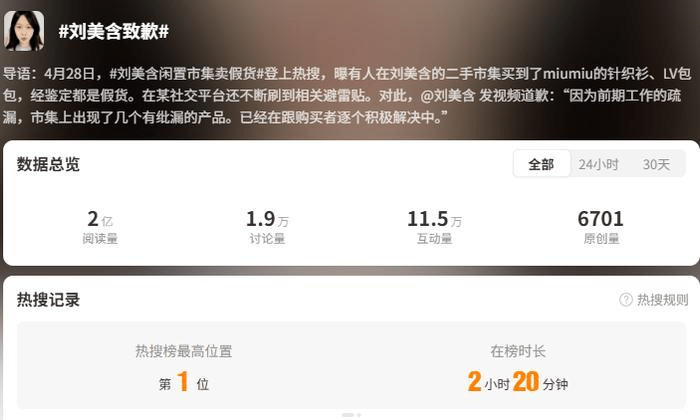
On the evening of April 28th, actress Liu Meihan released an apology video, stating that due to previous work oversights, several faulty products appeared at the market, and she had actively resolved the issues with each purchaser1. Subsequently, the hashtag “#Liu Meihan Apologizes” topped the 热搜 list1.
Public information shows that Liu Meihan was born on April 9th, 1991, in Shenzhen, Guangdong1. She is a singer and actress1. In 2008, she starred in the children’s fantasy drama Barbie Magic Fairies: The Pretty Princess, and her role as the little black fairy Yan Lili attracted attention1. In 2009, she participated in the Hunan TV talent show Super Girl and advanced to the national finals, ranking 15th nationally1. In 2010, she released her debut EP Ai Yiya with the Sino – Korean – Thai girl group i Me1. In addition, she has also appeared in TV dramas such as Secret Love in Orange Blossom, My Dear Lady, and The Great Rites of Zhenwu1.
The incident of Liu Meihan selling fake goods has also drawn attention to the booming domestic second – hand luxury goods market1. According to a report by Bain & Company, by 2030, mainland consumers’ contribution to global luxury consumption is expected to reach approximately 50%1. This trend reflects the growing influence and purchasing power of Chinese consumers in the global luxury market1. After more than a decade of rapid growth, the stock of the luxury market has already reached a trillion – yuan scale1. In countries such as Japan and the United States, second – hand luxury consumption accounts for nearly 30% of first – hand luxury consumption, while in China, it is less than 5%1. Referring to the 30% market proportion, there is still significant room for development in China’s second – hand luxury goods market1.
As the second – hand luxury goods market grows rapidly, the demand for product authenticity verification has also increased sharply1. The second – hand luxury goods industry has had a need for authentication since 2010, mainly relying on in – store visual inspections at that time1. Lu Xi, the operating director of Zhonghengxin, introduced to the 21st Century Business Herald reporter that the establishment of the authentication awareness mainly occurred in 2019 with the rapid growth of online live – streaming and the emergence of third – party authentication agencies1. By 2020, some platforms began to require merchants to ship goods to third – party authentication agencies, which would then ship the goods to consumers1. This move played a significant role in shaping consumers’ awareness of second – hand luxury goods authentication1.
Now, this trend is spreading to offline events1. Lu Xi said that even at offline second – hand luxury goods exhibitions aimed at individual consumers, providing authentication services has become an inevitable trend to dispel customers’ doubts about the authenticity of goods1. This year, the trend of offline exhibition authentication services is relatively stable, but the number of organizers seeking cooperation has increased compared to the same period last year1. “Many of the exhibitions we participated in this year are new ones1. We will bring portable equipment and at least two authenticators, and the unified fee is 70 yuan per item, mostly borne by merchants1. Many consumers even bring their own bags to be authenticated when they know there is a second – hand luxury goods exhibition1.” In Lu Xi’s view, consumers have gradually come to expect offline exhibitions to be equipped with authentication services, which has become a promotional highlight for merchants1.
 Chinatimenow
Leave a comment